Check Point warns of SmartConsole zero-day exploited in attacks
Israeli cybersecurity firm Check Point Software has addressed an actively exploited zero-day flaw in the company's SmartConsole graphical user interface (GUI) admin panel.
Tracked as CVE-2026-16232, this authentication bypass vulnerability allows unauthenticated attackers to obtain an application login token that can be used to authenticate with administrator privileges.
After gaining access to a vulnerable Security Management Server or Multi-Domain Security Management Server (MDS), attackers can change the security configuration and security policy.

Check Point added that successful exploitation requires no restrictions on Trusted Clients (GUI clients) and the Management Server IP to be exposed to remote access via the Internet.
"Successful exploitation allows the attacker to modify security policies and security configurations. Remote exploitation requires internet access to the Management Server IP address and a configuration that does not restrict Trusted Clients," the company said in a Sunday advisory.
"Check Point is aware that this vulnerability is being exploited and has affected a very small number of customers."
Admins who can't immediately upgrade to a patched version are advised to follow the Check Point Hardening Best Practices Guide, limit Trusted Clients to trusted IP addresses/subnets, and ensure that management access is blocked for non-authorized IP addresses.
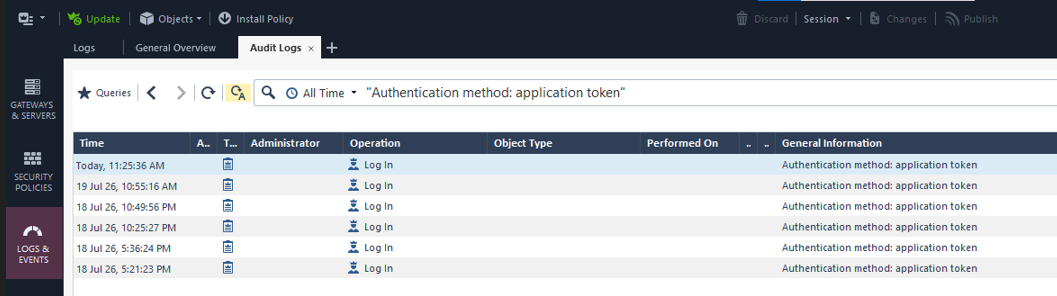 Checking SmartConsole logs for signs of compromise (Check Point)
To verify if a SmartConsole instance has been compromised, admins have to search for the query "Authentication method: application token" in SmartConsole under Logs & Monitor / Logs & Events > Audit Logs View after running the following SmartConsole query:
(src:151.241.99.207 OR dst:151.241.99.207 OR src:151.241.99.233 OR dst:151.241.99.233 OR src:158.62.198.182 OR dst:158.62.198.182 OR src:192.142.10.99 OR dst:192.142.10.99 OR src:139.28.37.250 OR dst:139.28.37.250)On Wednesday, the Cybersecurity and Infrastructure Security Agency (CISA) also added the flaw to its catalog of known exploited vulnerabilities, ordering U.S. federal agencies to patch vulnerable SmartConsole instances by Saturday, July 25, as mandated by Binding Operational Directive (BOD) 26-04.
"This type of vulnerability is a frequent attack vector for malicious cyber actors and poses significant risks to the federal enterprise," the cybersecurity agency warned.
While BOD 26-04 applies only to U.S. government agencies, CISA urged all organizations to prioritize patching the CVE-2026-16232 vulnerability to block incoming attacks.
In June, CISA ordered federal agencies to secure their Check Point Remote Access VPN and Mobile Access deployments against another authentication bypass vulnerability (CVE-2026-50751) that was exploited in zero-day attacks by the Qilin ransomware gang.
Two years ago, the cybersecurity agency flagged another flaw (CVE-2024-24919) in Check Point's Quantum Security Gateways as actively exploited by ransomware gangs, confirming an Orange Cyberdefense CERT report linking it to NailaoLocker ransomware attacks.

Test every layer before attackers do
Security teams log 54% of successful attacks and alert on just 14%. The rest move through your environment unseen.
The Picus whitepaper shows how breach and attack simulation tests your SIEM and EDR rules so threats stop slipping by detection.
What's Your Reaction?
 Like
0
Like
0
 Dislike
0
Dislike
0
 Love
0
Love
0
 Funny
0
Funny
0
 Wow
0
Wow
0
 Sad
0
Sad
0
 Angry
0
Angry
0







Comments (0)