

What butterfly wings have in common with barbershop poles
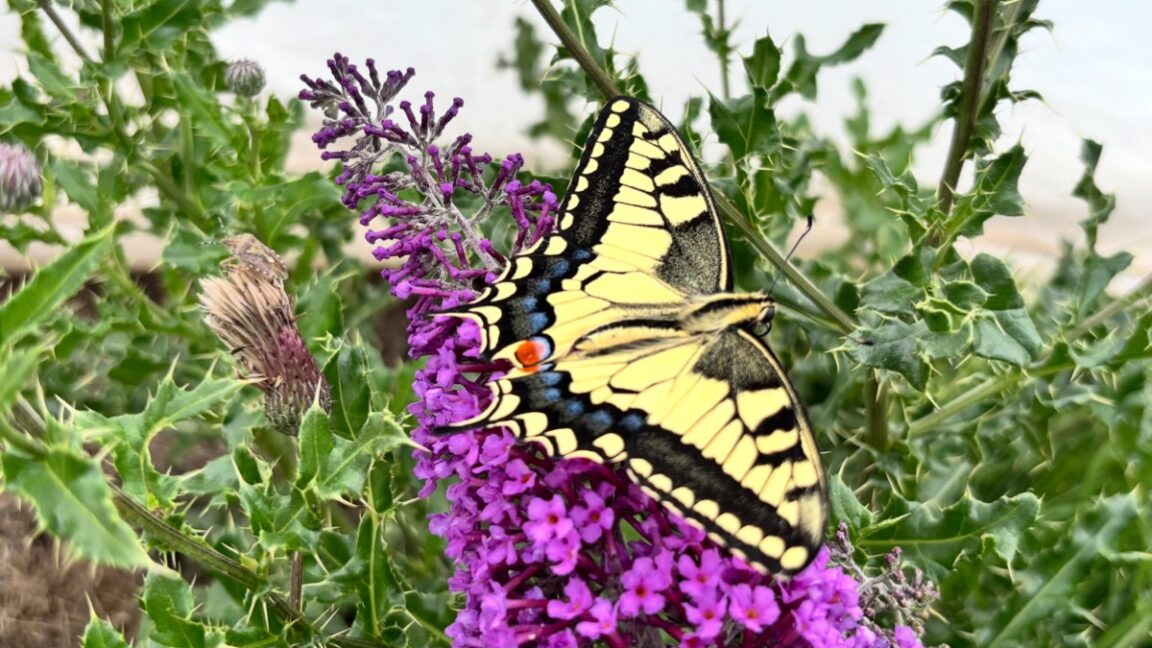
In other words, the motion effects looked a lot like the barbershop pole illusion. It has to do with the nature of butterfly flight: the wings deform as they flap, coming together on the upstroke and separating on the downstroke. This causes the stripes to shift angles and point in different directions. Combine that with their unpredictable flight paths, and you’ve got a highly effective anti-predator strategy. Per the authors, this is the first empirical evidence for motion dazzle effects produced by butterfly wings.
Credit: George R.A. Hancock and Jolyon Troscianko
Next, they created simulations of nearly 400 European butterfly species to see if motion illusion patterns were widespread; they were. A third phase involved human volunteers interacting with the virtual butterflies, trying to catch them on a touchscreen. Finally, the team ran genetic algorithms to simulate the evolution of over 50,000 wing patterns, programmed to select for those that created the strongest motion dazzle effects. The algorithms selected patterns that were strikingly similar to those found in nature, so this illusory effect could be a major evolutionary driver.
The dazzle effect can be achieved in several ways: contrasting vertical forewing stripes, a single vertical band, or internally contrasting wing margin patterns. And this function is likely complementary to other proposed adaptive functions of butterfly wing patterns. The next step is to improve the simulations to account for ventral wing patterning as well as more sophisticated flight dynamics. The authors, however, do not think this will alter their overall conclusions but will merely add more nuance to these initial findings.
“The dazzling stripes on zebras and snakes have long been suspected of confusing predators’ motion perception, but firm evidence has been hard to come by,” said Troscianko. “Our study gives us a genuinely new way to analyze motion vision, and we think motion confusion is likely to be far more widespread in nature than previously realized, from the flapping wings of birds to the flicking tails of lizards and fish. It opens up an exciting new research avenue.”
Nature, 2026. DOI: 10.1038/s41586-026-11062-w (About DOIs).
What's Your Reaction?
 Like
0
Like
0
 Dislike
0
Dislike
0
 Love
0
Love
0
 Funny
0
Funny
0
 Wow
0
Wow
0
 Sad
0
Sad
0
 Angry
0
Angry
0










Comments (0)