

Think tank games out how to respond to disaster scenarios in space warfare
“Where does the threshold live that an action necessitates some proportional reaction?”
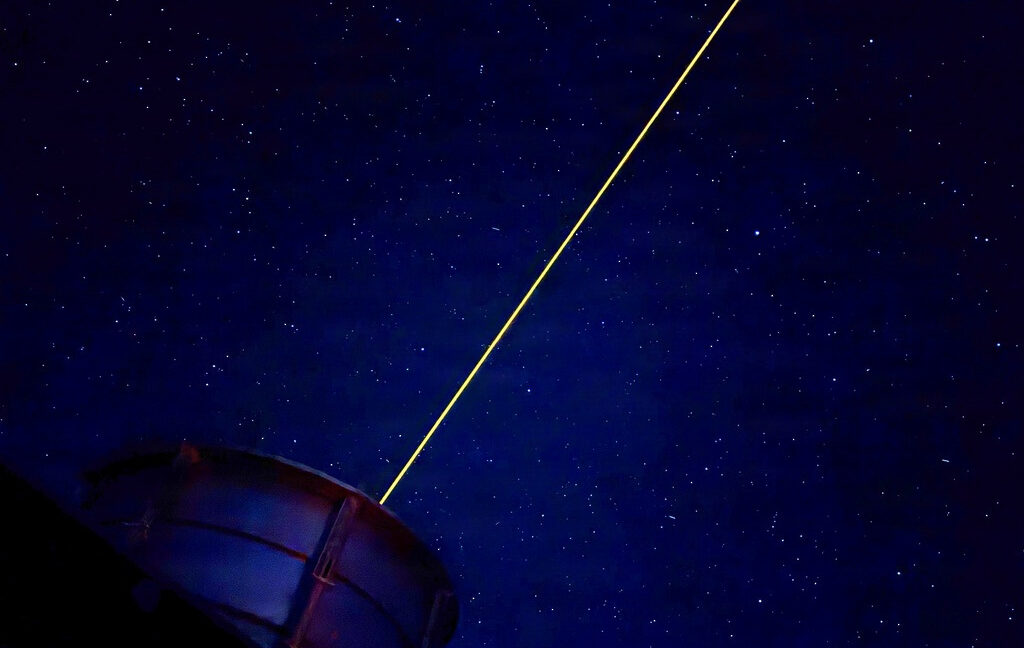
The sodium laser guide star projects into the night sky from the Advanced Electro-Optical System telescope, a 3.6-meter telescope, at the Maui Space Surveillance Complex atop Haleakalā, Hawaii, on June 9, 2026. The laser creates an artificial reference star used to improve image quality during optical observations, enhancing the site's ability to support space domain awareness operations. Credit: US Space Force/Connie Dillon
Imagine this: The US military begins tracking a mysterious spacecraft maneuvering near one of the Space Force’s missile-warning satellites more than 22,000 miles over the equator.
This US satellite cost several billion dollars to build and launch. It’s one of a handful of sentinels keeping constant watch for ballistic missile launches that might threaten the US homeland or US military bases overseas. Suddenly, this missile warning satellite goes dark. Ground controllers at a military base just outside of Denver scramble to figure out what went wrong.
There are two possibilities. Perhaps the mystery spacecraft lurking nearby somehow disabled or destroyed it, or as sometimes happens in the unforgiving environment of space, something important broke on the satellite, rendering it unresponsive. If the former, was it an intentional attack or an accident? Who carried it out and why? If the latter, how might controllers reactivate the satellite?
These are questions that could easily cloud decision-making in a key moment of uncertainty. How should a military commander respond? A think tank staffed with retired Air Force and Space Force officials gamed out such scenarios in a two-day workshop earlier this year. They reported on their findings and recommendations last week.
“We had 50 subject matter experts from military, government offices, industry, as well as academia join us,” said Charles Galbreath, a retired Space Force colonel and director and senior resident fellow for space studies at the Mitchell Institute for Aerospace Studies. “We wanted to understand how a conflict in space might manifest and what we and our allies or our partners could do to prevail in each of those situations.”
The workshop’s facilitators posed a series of hypothetical adversarial actions, or vignettes, to the participants. All of the scenarios began with a “show of force” from China, which docked one of its satellites with an inoperable European commercial satellite and repositioned it in orbit without prior coordination. The organizers then told participants of additional hostile activities occurring at predetermined intervals, with attacks attributed to China, Russia, Iran, and an unidentified actor.
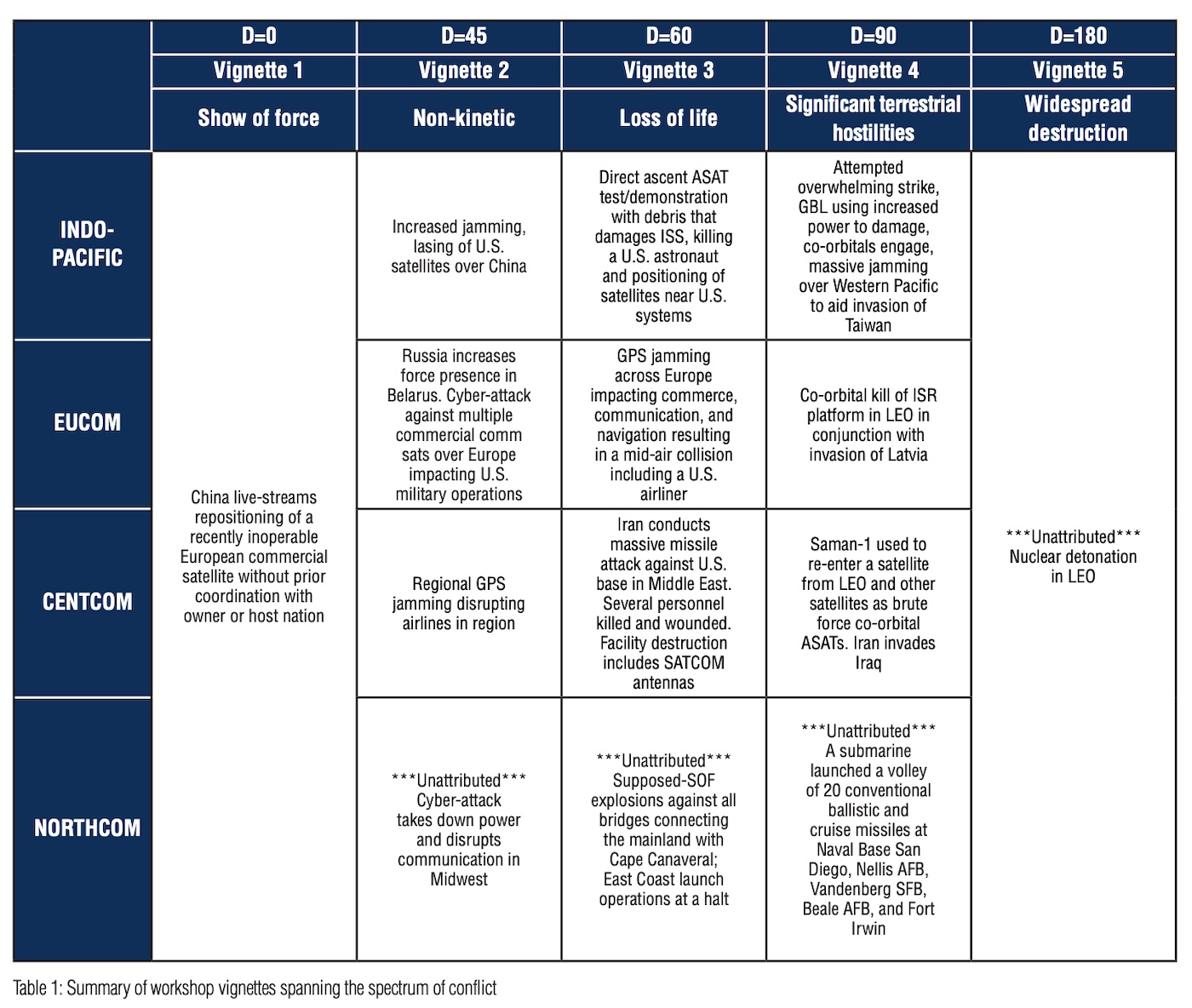
The workshop presented a series of scenarios to participants. The simulated events at days 0, 45, 60, 90, and 180 included attacks in space and on the ground.
Credit: Mitchell Institute for Aerospace Studies
The workshop presented a series of scenarios to participants. The simulated events at days 0, 45, 60, 90, and 180 included attacks in space and on the ground. Credit: Mitchell Institute for Aerospace Studies
US and allied military commanders would have to decide when and how to respond in such scenarios. Governments might prefer a diplomatic response over a military reaction in some situations. If a military response is warranted, should it be in space or in another domain, like land, sea, air, or cyber? All of these domains are inextricably linked, with terrestrial infrastructure enabling space operations and space-based assets supporting military activities on Earth. An attack on one inevitably affects the other.
“It was really no surprise, but conflict in space is a complex topic,” Galbreath said.
Unraveling these complexities could take time, delaying a US response.
“Because there are still few widely accepted definitions for what constitutes conflict in space, decision-making can become slower, less certain, and more reactive,” said retired Air Force Col. Jennifer Reeves, a coauthor on the Mitchell Institute’s report.
Boiling the frog
It’s also easy to get lulled into a sense of normalcy or complacency. GPS jamming and cyberattacks on space-related infrastructure are already happening, and it’s sometimes difficult to find who is doing them.
“The workshop also underscored the central importance of attribution,” Reeves said. “Before leaders can choose a credible response, they need confidence about what happened, who did it, how broad the effects were, and whether those effects were actually intentional.”
“This ambiguity creates opportunity for our adversaries,” Reeves said. “Repeated non-kinetic attacks, those things like jamming, lasing, and cyber effects can gradually normalize hostile behavior if they are not clearly identified and addressed over time. That can desensitize us to actions that in another context would be seen as deeply provocative. This is why the workshop emphasized the danger of what some participants described as a ‘boiling the frog dynamic.’ If pressure is applied slowly and persistently, the threshold for response keeps moving.”
The result is that we risk seeding initiative to competitors who are shaping the environment before open conflict ever begins,” she continued. “The core takeaway here is simple: If we want space superiority in crisis or conflict, we have to think and act earlier in the competition phase.”
The workshop also explored how potential adversaries might work together during coordinated assaults. For example, how should the US respond as attacks escalate from GPS jamming to a missile strike in the Middle East, then to an attack on bridges at Cape Canaveral, Florida, grinding launch activity to a halt at the world’s busiest spaceport?
“Participants viewed coordinated behavior by multiple states as significantly more escalatory than isolated actions by a single actor when space-related pressure occurs alongside other regional or global crises,” Reeves said. “The challenge of maintaining escalation control simply becomes much harder.”
But there’s more to it than military response options. Galbreath and Reeves, along with their coauthor, Kyle Pumroy, emphasized the importance of “strategic messaging” for US officials to define norms of behavior and set the narrative for future conflict. The workshop’s participants also stressed that the US military has a broad set of response options, coupled with more resilient space architectures to deter an attack in the first place. The US Space Force is already moving in this direction with its use of mega-constellations for communications and surveillance.
“If our architectures are more survivable and if we can reconstitute capability faster than an adversary can degrade it, then we reduce any first-mover advantage,” Reeves said. “So the bottom line here is that legitimacy, capability, resilience, and speed all work together.”
The authors recommended that the US government and its commercial and international partners establish benchmarks for interpreting hostile behavior in space. This would “eliminate some of the ambiguity, as well as delay, in formulating response options,” Galbreath said.
“There needs to be an active campaign of what is acceptable, what isn’t acceptable, what we consider to be critical elements of our infrastructure, a reminder to everybody of why space capabilities are so critical to our national security and our way of life,” Galbreath said.
They also recommended that the Space Force continue conducting war games and enhancing the protection of US space infrastructure on the ground and in space. Perhaps, Galbreath said, the Space Force should consider improved radiation shielding for its satellites in low-Earth orbit to protect them against a potential nuclear detonation.
US officials should also better define the importance of satellites. “Are they just unmanned vehicles, or are they critical elements of our infrastructure that are interwoven to every aspect of our daily lives? I vote for that one,” Galbreath said.
So where do the world’s leading space powers stand on the spectrum of competition today?
“It was really one of the clearest takeaways from the workshop that so many people believe we’re already there,” Reeves said. “We’re already in the gray zone because of these hostile actions, and they’re genuinely hostile, but they’re more isolated. They happen every so often. Jamming, lasing, cyberattacks are happening, and even some coercive maneuvers, like when we’re not exactly sure why a particular asset got moved up next to another non-aligned asset in space.”
“Individually, it feels like that these actions don’t necessarily cross the traditional threshold for war, but… we’re getting used to these things happening,” Reeves said. “These actions are being normalized to some extent, so now, where does that line live? Where does the threshold live that an action necessitates some proportional reaction? I think this deserves a lot more conversation on the policy level than we may be giving it. We’re just getting used to it. We’re boiling that frog.”

Stephen Clark is a space reporter at Ars Technica, covering private space companies and the world’s space agencies. Stephen writes about the nexus of technology, science, policy, and business on and off the planet.
What's Your Reaction?
 Like
0
Like
0
 Dislike
0
Dislike
0
 Love
0
Love
0
 Funny
0
Funny
0
 Wow
0
Wow
0
 Sad
0
Sad
0
 Angry
0
Angry
0




Comments (0)