

New 'BlueMoon' kit exploited Windows and Chrome zero-day flaws

Multiple cyber-espionage groups deployed an exploit kit dubbed “BlueMoon” that leveraged zero-day vulnerabilities in Microsoft Windows and Google Chrome.
BlueMoon combines two security issues in Chromium-based browsers that allow remote code execution and sandbox escape with a kernel local privilege escalation in Windows.
The kit appears to be a shared modular tool that supports exploit additions and was used in distinct operations.
Researchers at enterprise cybersecurity company Proofpoint observed BlueMoon being used since August 28 in spearphishing operations attributed to the JungleBamboo (a.k.a. APT31, Violet Typhoon, APT31, Tide Castle) threat actor associated with China.
Cybersecurity and threat intelligence company Volexity also observed similar activity on September 1st, in campaigns from another actor it tracks as UTA0560 that targeted "customers at multiple non-governmental organizations (NGOs)."
According to the researchers, the BlueMoon developer maintainers take advantage of the delay between public Chromium fixes and stable Chrome releases, reverse-engineer public code changes, and create exploits to target downstream browser users.
The three flaws chained by the BlueMoon exploit kit are:
- CVE-2026-85046: a type-confusion flaw in Chrome’s V8 JavaScript engine that provides arbitrary memory access inside the V8 sandbox
- CVE-2026-87491: a V8 sandbox escape that corrupts WebAssembly metadata to run embedded shellcode
- CVE-2026-85880: a heap-based buffer overflow in Windows ALPC that allows local privilege escalation
Proofpoint says attackers exploited CVE-2026-85880 as a classic zero-day, suspecting it has been leveraged since 2025 and repackaged in BlueMoon.
“The LPE DLL compilation timestamp is from 2025 and did not appear to be forged,” Proofpoint explains.
“This - combined with the exploit targeting older Windows builds - suggests that the exploit creator repackaged an existing capability into the BlueMoon exploit kit.”
BlueMoon runs the exploit inside a Web Worker, retrying it up to five times. It fingerprints the system, exploits the Windows privilege elevation flaw to elevate the Chrome renderer, and injects into Chrome’s parent process to run an operator-selected command.
The default final command uses curl to save an executable, typically a malware loader, under %TEMP% and run it.
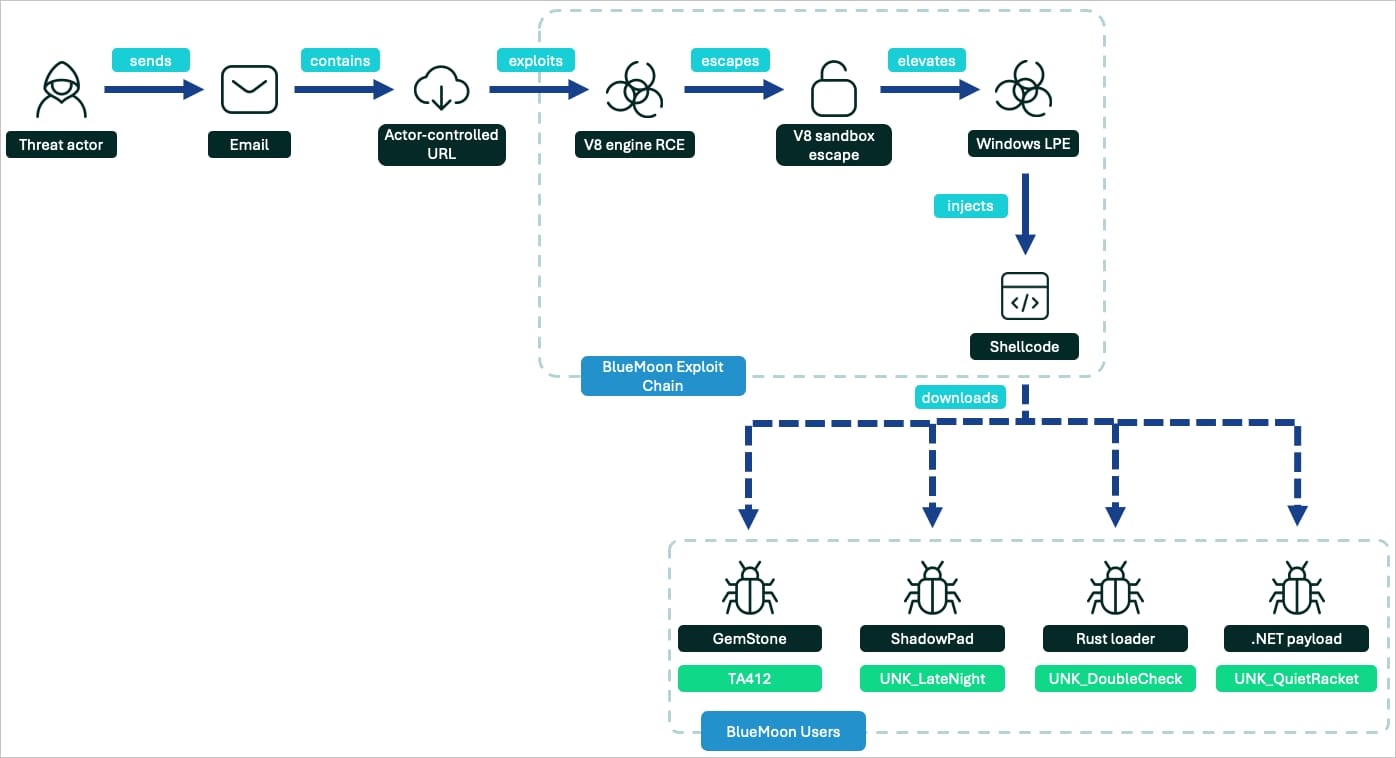 BlueMoon attack chain overview
Source: Proofpoint
Threat groups and targets
The reports from Volexity and Proofpoint [1, 2] identify four distinct activity clusters associated with BlueMoon deployments, three of them described as Chinese or China-aligned.
JungleBamboo, the first Chinese state-sponsored actor observed using BlueMoon, is known for targeting NGOs in the US, mining companies, and individual high-value targets, using the Longtale/GemStone credential stealer extension disguised as Google Gemini.
The second hacker group is UTA0560, which targeted NGOs using donation lures and triggered an infection chain that delivered Grimwedge, an in-memory JScript backdoor for reconnaissance, file and process management, command execution, and payload uploads.
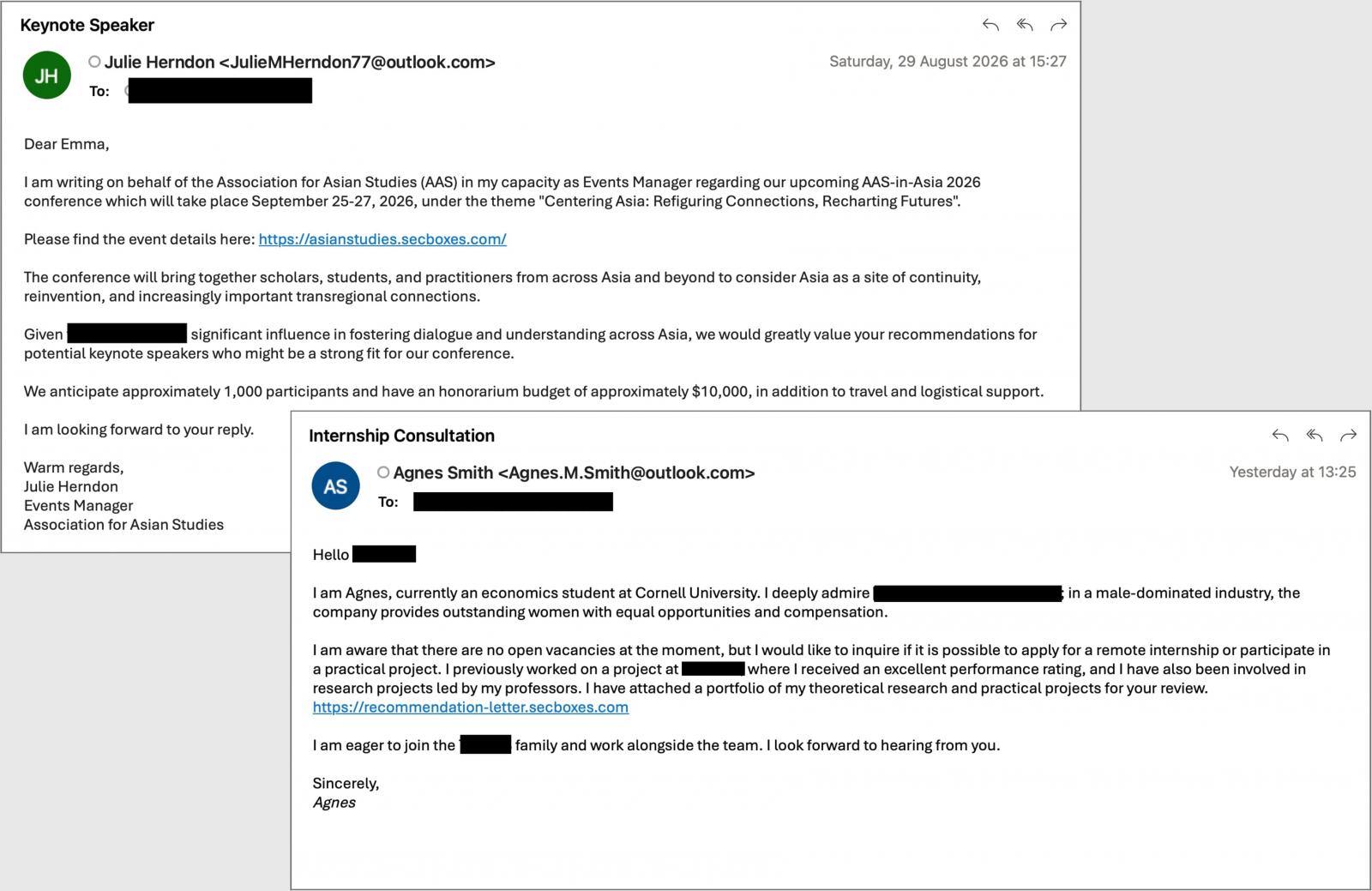 Phishing emails used in the attacks
Source: Proofpoint
The third cluster is tracked as UNK_LateNight, known for deploying the ShadowPad backdoor on systems belonging to U.S. aerospace and defense-industrial-base companies.
A fourth group, tracked as UNK_DoubleCheck, targeted Vietnamese manufacturing firms with an in-memory Rust loader, though the final payload couldn’t be retrieved for analysis.
Proofpoint expects BlueMoon adoption and deployment to increase, potentially reaching financially motivated attackers in the future, so defenders are advised to use the provided indicators of compromise in both reports to block the activity early.
Both cybersecurity companies shared indicators of compromise for files and network infrastructure observed in attacks using the BlueMoon exploit kit.

Once attackers have valid credentials, only 37% of their actions are blocked
Overall prevention scores can hide what happens after initial access. Once attackers are using valid credentials, prevention drops sharply.
The Blue Report 2026 measures defenses technique by technique across 338 million simulations run in customer production environments.
What's Your Reaction?
 Like
0
Like
0
 Dislike
0
Dislike
0
 Love
0
Love
0
 Funny
0
Funny
0
 Wow
0
Wow
0
 Sad
0
Sad
0
 Angry
0
Angry
0








Comments (0)