

Most of our measures of a key cognitive process don't agree

The amygdala is a structure deep in the brain that tends to be active when people have emotional responses to events (as well as in a wide variety of additional circumstances). So, it makes sense to expect that it would be less active if people were trying to tone down their emotions. But to find out whether that’s actually correct, you need to look at brain activity. Here, the team relied on 40 functional MRI data sets, providing a large enough data set to tease out even relatively small effects.
Which is a good thing, because the effects really were hard to detect. “The effect size was comparatively small: To detect this effect size with a statistical power of 80 percent, a single study would need to test 1,105 participants,” the researchers note, going on to say that very few fMRI studies have access to anywhere near that many subjects.
But there were even bigger problems when the differences among individuals in the MRI data were compared to their differences in the questionnaires or task-based ratings. Almost none of the variance in the different measures correlated with each other. We could go through the numbers, but a figure from the paper makes the issue quite clear.
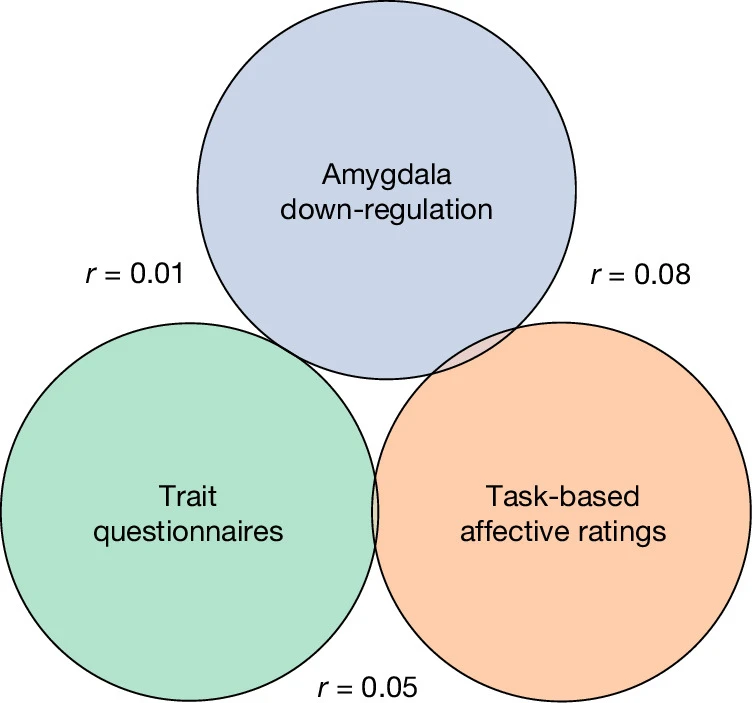
When one of the typical measures of emotional regulation varies, it rarely varies in a consistent way.
When one of the typical measures of emotional regulation varies, it rarely varies in a consistent way. Credit: Sicorello et. al.
An issue of timing?
Further issues became apparent when the researchers started looking at activity in the areas of the brain that are responsible for high-level decision-making. If people were really engaging their ability to re-evaluate emotional triggers, presumably these areas should be active, as they are needed to power the re-evaluation process.
But that wasn’t what the fMRI data showed. Instead, there was a correlation between the response of the amygdala and the response elsewhere in the brain. In other words, if the amygdala was very active, implying a stronger emotional response, then activity in the decision-making areas of the brain was also higher. If the emotional response seemed tamped down, then activity in the reasoning centers was lower as well.
What's Your Reaction?
 Like
0
 Dislike
0
 Love
0
 Funny
0
 Wow
0
 Sad
0
 Angry
0










Comments (0)