

Kali Linux 2026.3 released with 6 new tools, desktop updates

Kali Linux has released version 2026.3, its third release this year, featuring six new hacking tools, desktop environment improvements, refreshed build scripts, and more.
This Linux distribution is available as an installable OS or as a live environment and supports a wide range of hardware, including Raspberry Pi devices and Android phones via Kali NetHunter.
Kali is designed for ethical hackers and cybersecurity professionals who want to perform red-teaming, penetration testing, security assessments, and network research.
New tool added to Kali Linux 2026.3
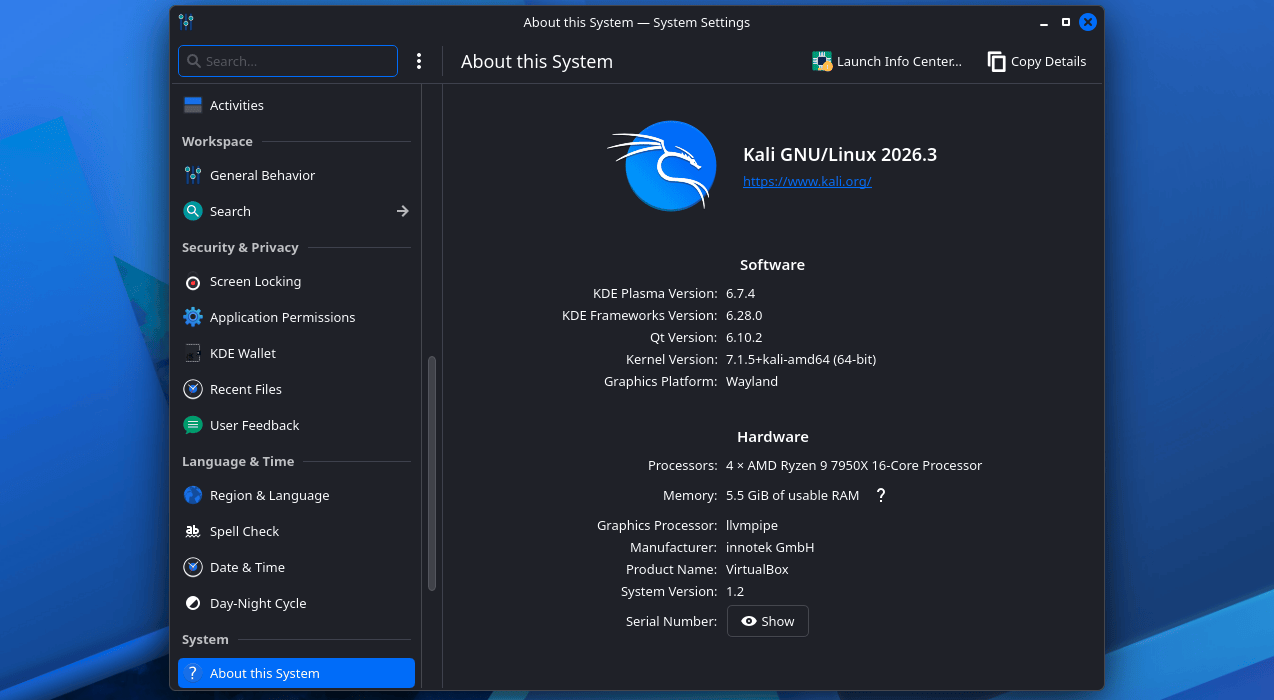
In this release, the Kali Team has updated 126 packages, added new libraries, and upgraded the kernel from 6.19 to 7.1.5.
It has also added 6 new tools, including:
- dalfox - Powerful open-source XSS scanner and utility focused on automation
- katana - Next-generation crawling and spidering framework
- qsreplace - Accept URLs on stdin, replace all query string values with a user-supplied value
- rustscan - Modern port scanner
- sdrangel - Qt-based SDR front-end for various devices
- snaffler-ng - SMB share credential and sensitive data scanner
Desktop environment updates
Kali Linux 2026.3 also brings desktop environment updates, including KDE Plasma 6.7 and new icons.
KDE Plasma 6.7 includes performance and integrated Intel GPU power-usage improvements, plus workflow optimizations.
These changes include per-screen virtual desktops that let you create separate workspaces on the same desktop for web browsers, terminals, and documentation.
"Moving around those desktops is also quicker from the Overview, while support for additional Wayland protocols and portals continues to improve the experience on modern Linux setups," the Kali devs explained.
"Network connections can now be duplicated, which can save some time when working with several similar network configurations, and System Monitor has received further refinements."
 KDE Plasma 6.7 (Kali Linux)
Build-scripts refresh
This version also refreshes the build scripts used to generate official Kali images, with support for Docker and Podman containers and more consistency across platforms.
"We've brought consistency to our build-scripts across platforms. Each one now has the same features, command-line arguments, structure and layout (where possible), and the same look and feel," the Kali Linux 2026.3 announcement explains.
"Would you rather build inside a container? That is now supported, with both Docker and Podman! Each refreshed build-script comes with build-in-container.sh, which detects which container engine you have, creates the build container, and then runs the build from within it."
While not all build scripts have been refreshed before Kali Linux 2026.3 was released, the team aims to have them all ready for Kali 2026.4 and wants to automate builds and workflows in the next stage of this process.
How to get Kali Linux 2026.3
To start using Kali Linux 2026.3, you can upgrade your existing installation, select a platform, or directly download ISO images for new installs and live distributions.
To switch, you can use the following commands to upgrade to the latest version:
echo "deb http://http.kali.org/kali kali-rolling main contrib non-free non-free-firmware" | sudo tee /etc/apt/sources.list sudo apt update && sudo apt -y full-upgrade cp -vrbi /etc/skel/. ~/ [ -f /var/run/reboot-required ] && sudo reboot -fIf you're using Kali on Windows Subsystem for Linux, you should upgrade to WSL 2 for better support of graphical applications. To check the WSL version on your system, run wsl -l -v in a Windows Command Prompt.
After upgrading to Kali Linux 2026.3, you can check whether the process was successful using the following command: grep VERSION /etc/os-release.
The complete changelog for the Kali Linux 2026.3 release is available on Kali's website.

Once attackers have valid credentials, only 37% of their actions are blocked
Overall prevention scores can hide what happens after initial access. Once attackers are using valid credentials, prevention drops sharply.
The Blue Report 2026 measures defenses technique by technique across 338 million simulations run in customer production environments.
What's Your Reaction?
 Like
0
 Dislike
0
 Love
0
 Funny
0
 Wow
0
 Sad
0
 Angry
0








Comments (0)