

Is MAHA dying—or will it be reborn? What's next after crushing midterm losses?
RFK Jr.’s Make America Healthy Again movement was in trouble before voting began.
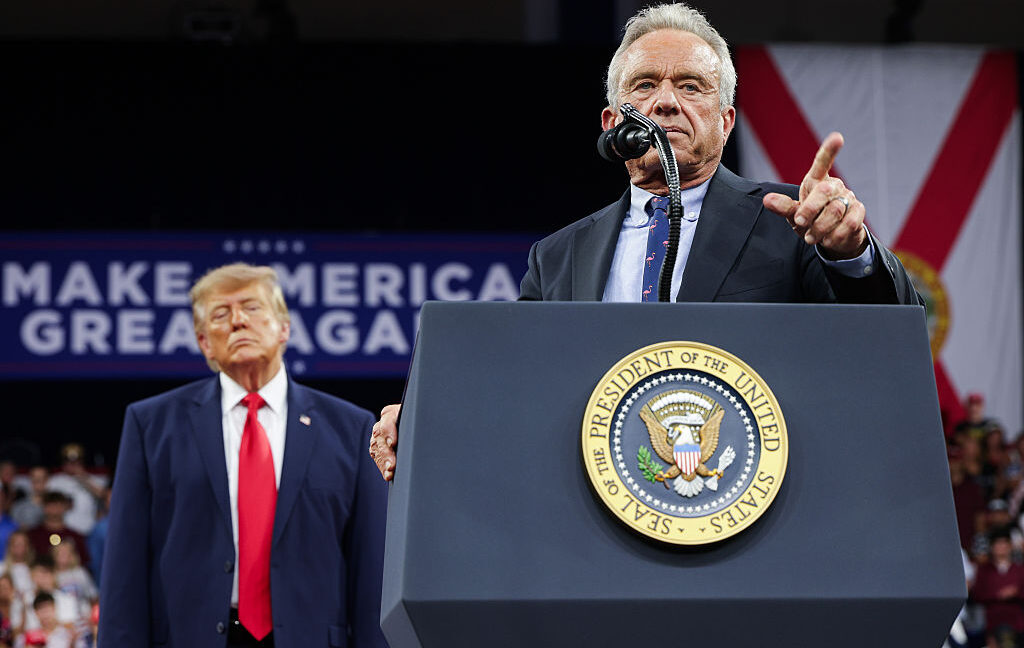
U.S. President Donald Trump (L) listens as U.S. Secretary of Health and Human Services Robert F. Kennedy Jr. speaks during an election rally on October 23, 2026 in Fort Myers, Florida. Credit: Getty | Alex Wong
As Democrats blew away their Republican rivals in an unprecedented midterm sweep Tuesday, the Make America Health Again movement also got bowled over, raising questions about the fate of the motley movement.
MAHA—which has centered around anti-vaccine activist and current Health Secretary Robert F. Kennedy Jr.—saw many of its favored candidates and allies lose, while vocal adversaries of Kennedy won. And the coalition was splintering under stress even before the voting started; in recent months, supporters have accused Kennedy and the Trump administration of inaction and betrayals in their two years in power.
Now hobbled in Washington, shedding supporters, and showing little to no influence in voting booths, is MAHA on its deathbed? Or will it be reborn—possibly into a new group? Could it be assimilated into a blue platform—after sloughing off the more repulsive, conspiratorial aspects of Kennedy’s ideology? These are the questions circling in the aftermath of Tuesday’s bloodbath.
In a social media poll Wednesday afternoon, Mary Talley Bowden—a dejected MAHA activist, anti-vaccine advocate, and doctor reprimanded for prescribing ivermectin to treat COVID-19—polled her followers about what should come next. She offered three options: Start a third party, join the Democrats, or overthrow the GOP. As of publication time, joining Democrats trailed at just 3 percent of the votes. The remaining votes were roughly split between overthrowing the GOP—whatever that means—and forming a third party, which had a small lead at 49 percent.
Cracking coalition
That MAHA could fade out entirely or fracture into negligible shards seems like a very real possibility. Its collection of disparate groups and varied agenda items has always made its cohesiveness seem tenuous. A Politico poll in June revealed that people who identified as MAHA had different ideas of what the movement’s priorities are (or should be), as well as different political leanings, and sometimes opposing ideologies.
Some within the movement embrace (or at least accept) Kennedy’s fringe beliefs, such as his zealous anti-vaccine views, his rejection of germ theory, and his false claim that 5G is damaging our brains and causing cancer. Some also believe, like Kennedy, in chemtrails and want all mRNA vaccines banned. There are members who support his plan to ban water fluoridation and also seem fine with his false claim that Lyme disease was created by the US military as a military weapon.
Others, meanwhile, have been attracted to MAHA by the more reasonable, non-absurd issues Kennedy touts. Those include improving the quality of Americans’ food and diets, reducing their exposure to environmental contaminants, and limiting the influence of industry and corporate interests on Americans’ health, particularly limiting the sway of pharmaceutical and chemical companies.
With various priorities, Kennedy and MAHA leaders have spent the past two years finding ways to disappoint their members. Some like Bowdon are angered that Kennedy has yet to ban mRNA vaccines. In February, Kennedy sparked particularly intense backlash among supporters for embracing Trump’s decision to increase domestic production of the pesticide glyphosate—a pesticide many in the MAHA movement wanted banned. Kennedy further fueled feelings of betrayal in September by appearing at a MAHA-branded summit that had hefty corporate sponsorships, including from behemoths such as Walmart, Anthropic, OpenAI, Grail, and UnitedHealth.
“MAHA was supposed to expose the revolving door between money, industry and government, not build its own,” Robert Malone, a fringe scientist and previous Kennedy ally, wrote in a scathing response to the summit.
Signs of dying
Going into the midterms on Tuesday, the number of disenchanted MAHA members had mounted. In October, Tiffany Cianci, a former Kennedy supporter, published a MAHA scorecard, which lists 42 promises that Kennedy and leaders made to the MAHA members and then largely broke. The scorecard reports 37 promises broken, five partially fulfilled, and zero kept. One of the “partially kept” promises was removing synthetic dyes from foods, particularly children’s foods. Kennedy announced an effort to do that—with much ballyhoo—but later admitted that the FDA did not ban or even have an agreement with food companies to remove the dyes. Instead, Kennedy said he has an “understanding” with food companies. The dyes remain in foods.
In a press release, Cianci wrote that the scorecard revealed “an abysmal string of broken commitments and betrayals.” It also contained a direct quote from her, saying: “I believed deeply in the promise that MAHA represented, particularly the possibility of confronting chronic disease and building a healthier future for America’s children. But belief was never supposed to mean blind loyalty.”
The press release included quotes from several other prominent MAHA leaders, all expressing disappointment with Kennedy and the Trump administration. Later in October, Calley Means, a top ally and senior advisor to Kennedy, resigned from his position, reportedly “disillusioned” and frustrated by delays in food policy changes sought by MAHA.
Another prominent figure to fall out with Kennedy was Vani Hari, an online influencer who goes by “food babe” and has previously identified as a “MAHA Mom.” As voting results were streaming in Tuesday night, Hari posted a comment on social media that she had given Politico months earlier, saying: “Women don’t come out to vote for glyphosate and war,” referring to the pesticide Kennedy had embraced and the Iran war.
Midterm devastation
In the wake of the blue sweep, it’s clear that more than half of the 24 MAHA-endorsed candidates lost their races Tuesday. That includes Senate candidate Ken Paxton in Texas and Zach Lahn, who ran for governor of Iowa. Lahn in particular was considered a “dream MAHA candidate,” and his campaign was seen as a test of MAHA’s political influence. Kennedy himself headlined a political rally for Lahn last week, calling it “the most important election going on in this country.” Lahn lost to his Democratic opponent, Rob Sand, who flipped the seat with an 11-point spread, turning the office blue for the first time in 20 years.
Alex Clark Voetberg, who hosts a wellness podcast called Culture Apothecary for Turning Point USA, echoed Hari, pointing to the glyphosate betrayal as a reason for the defeats. “MAHA moms stayed home and it could’ve swayed some of these races that were unbearably close. Should’ve listened to our warnings on protecting glyphosate—but you needed Bayer for the war,” Clark Voetberg wrote on social media.
Otherwise, MAHA also lost allies, such as Senator Roger Marshall (R-Kan.), who founded a MAHA caucus in the Senate. Rep. Zach Nunn (R-Iowa) lost his seat in the House despite reports that Kennedy allegedly intervened in the race to help him win. Meanwhile, critics of Kennedy notched wins, including Representative-elect Richard Pan, a physician from California; Senator-elect Annie Andrews, a pediatrician from South Carolina; and Senator-elect Abdul El-Sayed, an epidemiologist with a medical degree from Michigan.
Many congressional Democrats are already raring to hold Kennedy to account and remove him—and several of the newcomers are eager to help make it happen. In August, Andrews laid out her plans for health priorities to South Carolina Democrats, saying, “I believe we need to fully fund the CDC and the NIH, and I believe we need to impeach and remove RFK Jr.”
El-Sayed has also sharply rebuked Kennedy and said he looks forward to holding him “accountable for all of the grift.” After Kennedy made egregiously bigoted remarks against Arabs and falsely claimed they don’t contribute to science and literature, El-Sayed called out Kennedy’s lack of qualifications to be US health secretary. “He is an expert in people who have contributed nothing to science,” El-Sayed said. (Kennedy has no background in science, medicine, or public health. He also has a loathsome record of making bigoted and racist comments.)
On Wednesday afternoon, Sen. Angela Alsobrooks (D-Md.) wrote on social media: “The time is now. RFK Jr. must resign or be fired. End of discussion.”
MAHA and Kennedy
If Kennedy is removed from office, the outlook for MAHA in its current form seems even murkier. On the one hand, Kennedy’s removal may make it easier for those in the movement to shed the divisive, abhorrent aspects of his ideology and focus on broadly popular issues—healthy foods, environmental contaminants, and industry influence. Such a move may help MAHA cement itself as a sustainable political fixture. But some of the most vocal figures in the MAHA realm are doggedly loyal to Kennedy, throwing such a transition into doubt.
Zen Honeycutt, an anti-vaccine activist and founder of Moms Across America, is one of those Kennedy loyalists. Honeycutt drew attention before the election for reaching out to Democrats on common causes. Her group endorsed several blue candidates, including Rep. Alexandria Ocasio-Cortez of New York, Sen. Cory Booker of New Jersey, and Rep. Chris Pappas in New Hampshire (all of them won their races).
“We expect Democrats and Republicans to work together,” Honeycutt told Politico earlier this month. “Health is not a political issue. You know, poison is not partisan. Cancer is not choosy.”
The sensible comment might suggest Honeycutt doesn’t care which party or politician follows through with MAHA’s goals, just as long as they’re achieved. But this is not actually Honeycutt’s position. Her intentions were made clear in exchanges on social media with Bowden, who harshly criticized Honeycutt for crossing party lines, particularly for talking with Ocasio-Cortez. “You understand she’s trying to use you?” Bowden wrote.
Honeycutt explained that she was working to smooth Kennedy’s path in Washington, not hand power to Democrats, who she said had been “fascist in mandating vaccines.” She instead turned the criticism to Bowden, saying the MAHA infighting and mudslinging was what was hurting the cause and handing Democrats wins.
On Wednesday, Honeycutt reaffirmed her allegiance to Kennedy, warning Democrats that impeaching him would be “extremely unwise.” She reposted a comment from one of her followers, writing: “I’m willing to give Dems a chance with their new power before I judge. I’m an independent. Kennedy is my red line. If they cross it I want them to get absolutely fucked in 2028.”
“Sums it up,” Honeycutt wrote.
The blue in MAHA
Still, there are some inklings that part of MAHA could be absorbed into blue platforms—whether the leaders of the movement in its current form like it or not.
Earlier this month, Brinda Adhikari, a journalist and co-host of the podcast Why Should I Trust You?, argued that MAHA wasn’t dying but remaking the Democratic Party to be more like its old self. In a Substack post titled How MAHA Is Making Democrats Democrats Again, Adhikari pointed to a health policy document from House Democrats with a section, led by Ocasio-Cortez, titled “Reclaiming MAHA and Protecting American Families.”
Adhikari wrote that some of the issues touted by MAHA are a natural fit for the Democratic Party. She stretched back to Rachel Carson’s seminal Silent Spring in 1962 and the progressive environmental activism that elevated issues of health, pesticides, toxic chemicals, and corporate influence over public health. “These were once bread-and-butter Democratic issues,” Adhikari wrote. “But somewhere along the way, Democrats lost some of their identity as the party leading these fights.”
Adhikari and Democrats credit Kennedy with redirecting attention to these issues, which have broad support among voters.
“Americans’ concerns about chronic disease and food safety, especially that which is linked to corporate influence over environmental regulation and public health, are legitimate and long overdue for a serious legislative response,” the House Democrat’s policy document reads. “The Make America Healthy Again (MAHA) movement has galvanized a significant segment of the Republican Party and attracted many previously apolitical and non-traditional voters, yet many of the concerns raised by the movement are bipartisan in nature.”
A KFF poll in May found that 75 percent of Americans want stricter regulations on food additives—a prominent MAHA priority—and 64 percent want stricter regulation of pesticides in agriculture, another key MAHA agenda item.
But Kennedy and the Trump administration have not only failed to deliver on these issues, but they have also spoiled the movement, using “the legitimate concerns of American consumers about food safety to spread misinformation about vaccines, public health, and science,” the policy document reads. “Their rhetoric has systematically led to the erosion of trust in public health, the science community, and decreased vaccination rates, leading to fatal outbreaks in some cases.”
Possible political shift
Democrats intend to reclaim the popular health and environmental issues, free of Kennedy’s corrosive anti-science rhetoric. The document outlines plans to restore regulations that protect clean water and air damaged by the Trump administration, advance policies to keep toxic substances out of food, and further Food is Medicine policies, which provide produce prescriptions to American families to improve nutrition and health.
Adhikari predicts a political shift. “I increasingly think MAHA’s most unexpected legacy may be pushing Democrats back toward their own roots: challenging corporate power, fighting dangerous chemicals in our food supply, and holding toxic polluters accountable,” she wrote.
MAHA leaders tied to Kennedy and the anti-vaccine movement, like Bowden and Honeycutt, are unlikely to get behind such a shift. This could cause MAHA’s political power—however strong it actually is—to fracture. MAHA leaders have claimed repeatedly that their followers have the ability to sway elections. If MAHA hadn’t been betrayed or at least disappointed by Kennedy and Trump in the last two years, MAHA could have prevented Tuesday’s Republican wipeout, they have said.
But the polling data doesn’t support the idea that keeping MAHA in its current form maximizes its political power. While MAHA does have significant support among voters—41 percent of US adults say they support MAHA—that support is primarily tied to the health, environmental, and food safety issues, which are popular among non-MAHA supporters, too. Further, just 4 percent of MAHA supporters cited vaccines and medical choice—Kennedy’s key issues—as their reason for supporting the movement, the KFF poll revealed.
Beyond MAHA’s primary issues, both voters overall and MAHA supporters specifically said MAHA issues weren’t top of mind this election; instead, both groups named the cost of healthcare as a bigger issue than those prioritized by MAHA (the MAHA movement is not associated with the issue of health care reform). A separate KFF poll on election day found that 50 percent of voters thought that the Democratic Party was better able to handle healthcare, while only 30 percent of voters said the same of the Republican Party.
For now, it’s unclear exactly how—or if—MAHA will influence the political landscape going forward. It could break apart, live on through revamped Democratic policies, or try to form a new political party entirely. And, apparently, there’s also the possibility it will try to overthrow the GOP.
Beth is Ars Technica’s Senior Health Reporter. Beth has a Ph.D. in microbiology from the University of North Carolina at Chapel Hill and attended the Science Communication program at the University of California, Santa Cruz. She specializes in covering infectious diseases, public health, and microbes.
What's Your Reaction?
 Like
0
 Dislike
0
 Love
0
 Funny
0
 Wow
0
 Sad
0
 Angry
0







Comments (0)