

F1 in Texas: The American race that fans love to attend
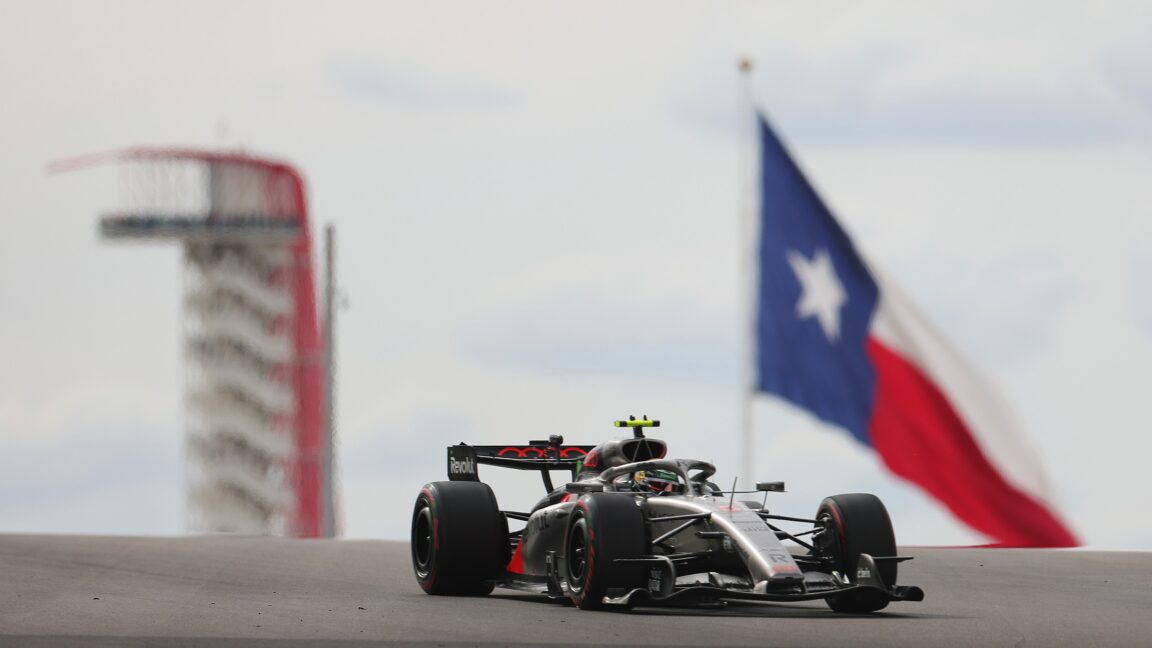
Ars spends the weekend with the Audi Revolut F1 team at the Circuit of the Americas.
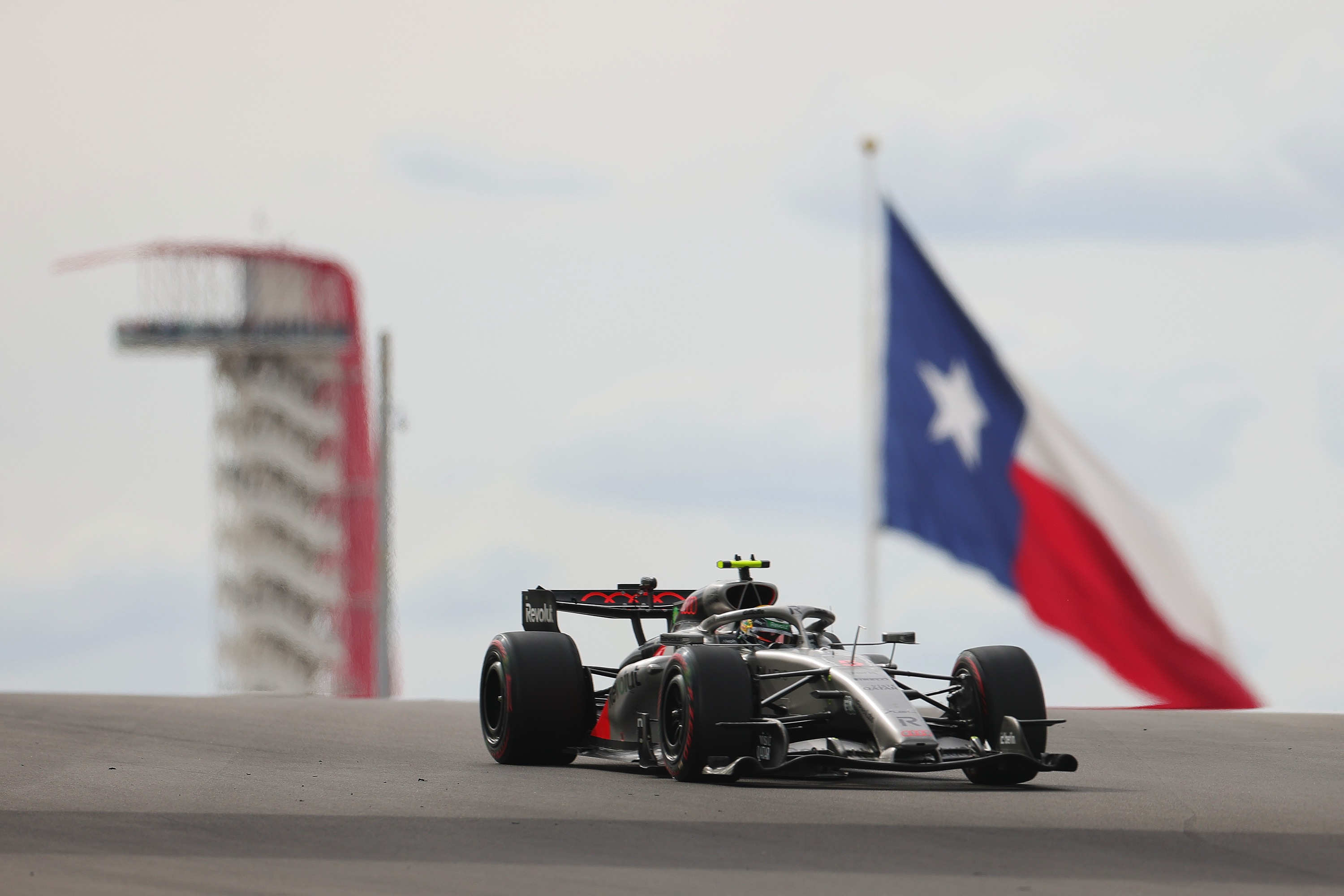
They like big flags in Texas. Credit: Alex Slitz/LAT Images
They like big flags in Texas. Credit: Alex Slitz/LAT Images
AUSTIN, Texas—Formula 1 returned to US shores this weekend with its annual visit to the Circuit of the Americas in Austin, Texas. Once in danger of falling off the calendar due to lack of interest, it’s now one of the most popular tracks on the calendar and, of the US’s three races, it’s the one the real fans mostly attend.
Unlike Miami or Las Vegas, which race on temporary street circuits, COTA is a permanent race track with plenty of run-off areas instead of concrete walls. Designed by motorcycle racer Kevin Schwanz—Herman Tilke’s company did only the buildings and infrastructure, contrary to popular belief—the track combines a mix of corner speeds with challenging turn sequences, a few heavy braking zones, and plenty of elevation changes.
It’s a place Ars knows rather intimately by now. We’ve driven it in everything from an Audi TT-S to a Corvette ZR1 to a bicycle, and that’s just in the real world. Over the years, we’ve been there for F1 to learn about how the sport puts together its broadcasts, how Pirelli designs its tires, and how various tech partners help teams manage their data and strategies. We even saw the race through a neophyte’s eyes. And that’s just F1—we’ve logged many hours there with the World Endurance Championship and IMSA for the Lone Star Le Mans races in sweaty September.
It’s changed a lot since I attended the first USGP back in 2012. There’s more landscaping. The grassy banks that surround the track are now covered in hospitality structures, including one connected to the paddock building by cable car, complete with not one but two swimming pools. Along its fringes, the skyline is now studded with rollercoasters and amusement rides, part of COTA’s diversification strategy that combines theme park, concert venue, and, of course, a place to race.
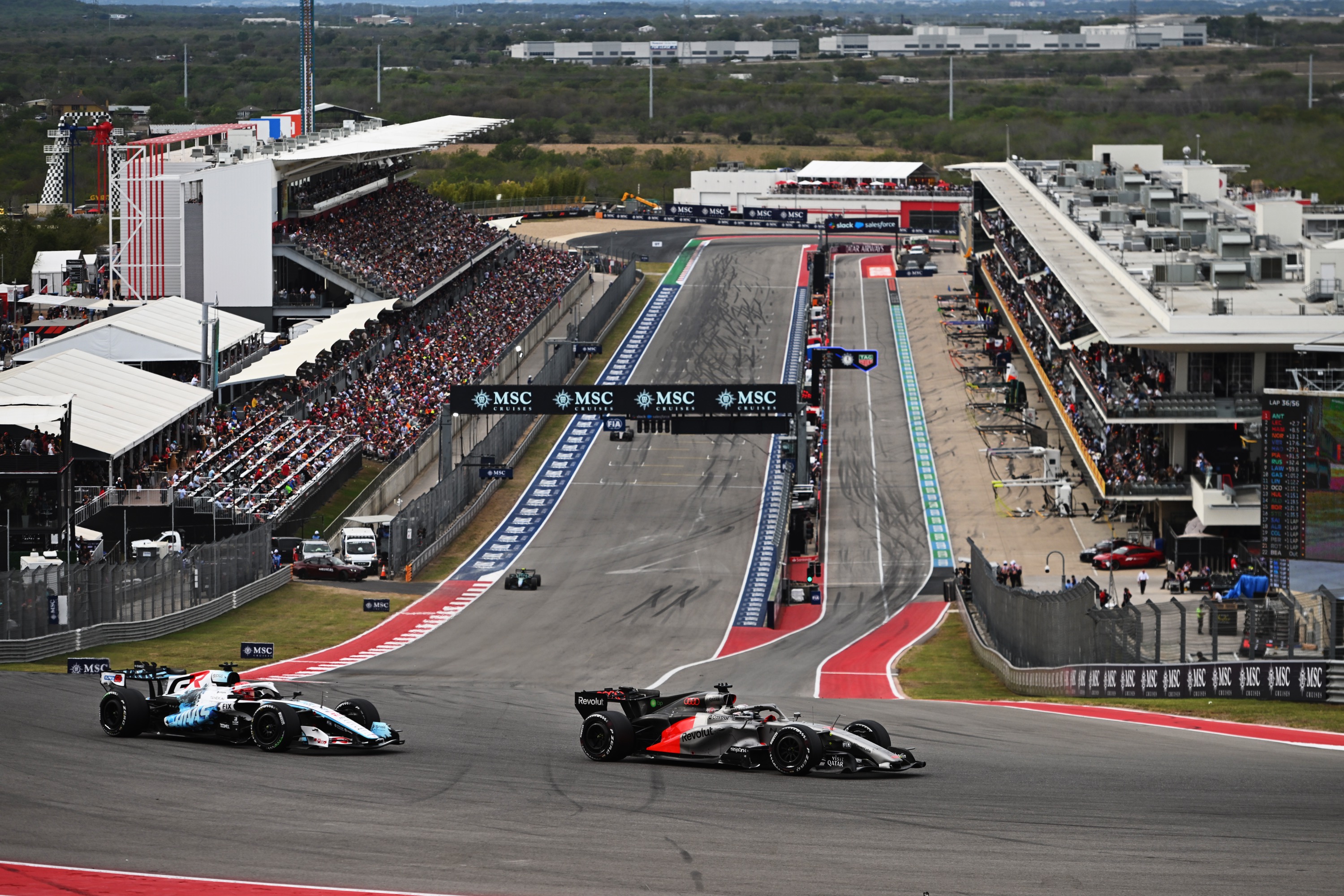
Turn 1 at COTA provides overtaking opportunities.
Credit: Rudy Carezzevoli/Getty Images
Turn 1 at COTA provides overtaking opportunities. Credit: Rudy Carezzevoli/Getty Images
The basic track layout hasn’t changed in those 14 years, but the track surface has. Between the earthworks required to create the elevation changes and the extremes of central Texas’ weather, it gets bumpier each year.
I asked Allan McNish if one of America’s newest F1 venues might be turning into a modern equivalent of Sebring, one of its oldest US F1 venues. Located in central Florida, Sebring’s bumpy concrete was poured during WWII when it was a B-17 training facility; these days, it’s one of the toughest sports car races on earth thanks to the torture it puts a car through. McNish would know: He’s racing director of Audi’s F1 team, but he was one of its star drivers during the marque’s glory days in endurance racing, with three Le Mans and five Sebring wins.
“It’s funny. Sebring is bumpy as hell. It hasn’t changed since Stirling Moss drove there in the ’50s,” McNish told me. “It’s the same piece of tarmac into [turn] 1 and 17 and everything else. But the characteristics of what you need for a 12 hours of Sebring—or for us as we used it for [testing for] Le Mans—was basically it just shook everything.”
“It wasn’t the damping side of it and the aero and the impact… but in reality, if it survived that beating, then it was going to have a good chance to survive in Le Mans,” he said. “Here it’s different because we’re shorter in terms of timing. It’s really bumps only in three places.”
Unfortunately for the drivers, those are three very important spots on the track: “the braking zones, which is because of the amount of energy that’s going in through the brakes, into the tire and then into the tarmac. It’s like if you slide on a carpet and put your feet down, then the carpet bunches up,” McNish said.
“It might cause some problems, might cause downshift issues or whatever because a car’s moving around—it’s inconsistent because of that. But that’s what it is. Circuit’s the same for everybody, get on with it,” he said, with a chuckle, adding that’s easy to say now as he sits behind the pit wall and not behind a steering wheel.
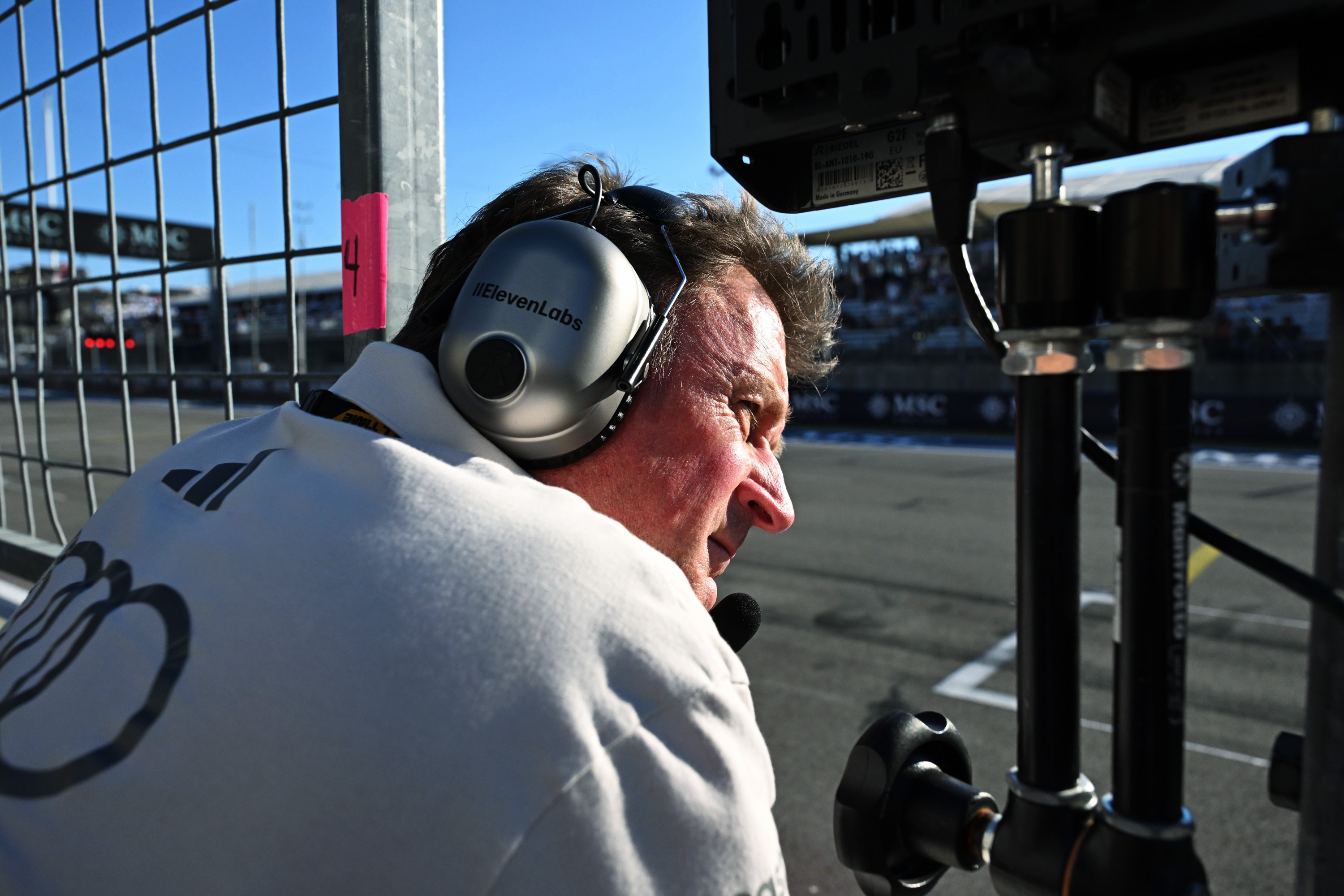
Allan McNish, the racing director of Audi F1 Team, looks on during practice ahead of the F1 Grand Prix of the United States at the Circuit of the Americas.
Credit: Mark Sutton – Formula 1/Formula 1 via Getty Images
Allan McNish, the racing director of Audi F1 Team, looks on during practice ahead of the F1 Grand Prix of the United States at the Circuit of the Americas. Credit: Mark Sutton – Formula 1/Formula 1 via Getty Images
As a former driver himself, McNish has insight into what his two drivers need from the team. “From my point of view, I do live inside the cockpit with them virtually when I’m watching what they’re doing, see what the car’s doing,” he said. “I understand when the car’s dancing around a little bit, what the reaction is and what they need from it and try and correlate the support in behind that with the engineering as well. So… I suppose my style is living it from the cockpit.”
Where’s Audi at?
2026 is Audi’s first year as an official F1 constructor, having completed its purchase of Sauber in 2024. The company wouldn’t be in the sport if it didn’t want to win races and championships, but it also recognizes that’s not the work of a minute. It has hardly embarrassed itself this year, though, considering it has no prior experience in the sport.
“We’re consistently fighting in and around Q3 [qualifying for the 10 fastest cars], which is now the point where you can get points,” McNish said. “So the momentum for us is the fact that we’re coming off best result for the weekend that we’ve had all year and career [in Singapore]. It’s the first time we’ve had a car in both the points in the sprint and in quali and the race. And at the same time, I think it was a really good one because we were so close in the two previous races and lost the point in the last lap, and that was hurting, really hurting.”
The team brought some aerodynamic upgrades to COTA, which it A/B tested during the first free practice session on Friday. “We brought one to Baku, which was a few races ago, and then this was the second part,” McNish said. “And that should give us a little bit more performance in the first sector. So basically through the fast esses, but also in the lower speed. And that’s maybe an area where we’ve—not so much lately—but struggled a little bit more earlier in the season.”
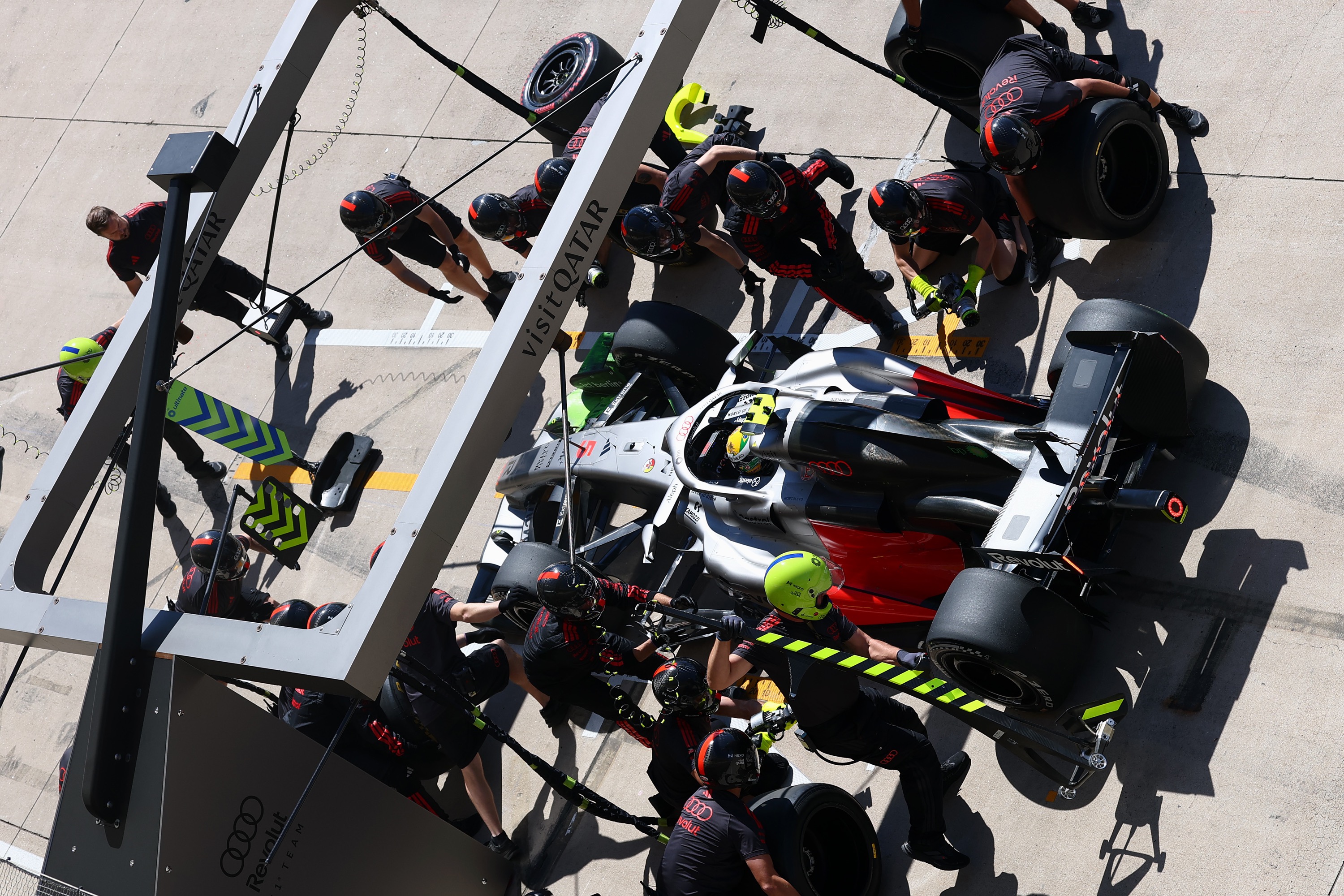
Pitstop practice.
Credit: Simon Galloway/LAT Images)
Pitstop practice. Credit: Simon Galloway/LAT Images)
That work is forward-looking. “That’s for next year so that we can be more confident as we go forward with our tools. We can’t control the opposition. We don’t know them. What we can control is what our roadmap is, where we are going and how we are going to get there,” McNish said.
“And our roadmap really looks toward 2030, not just ’27. So we’re looking in terms of all of our preparation toward that bigger goal with different things on the way,” he said. “I think what you will find next year is that the top four teams will be the top four teams. I don’t think that’ll change because it doesn’t change overnight in these situations. And we’ve got to improve in all of the areas.”
Right now, the Audi is good in medium- and high-speed corners but less effective out of the slow ones and in terms of straight-line speed. That is partly due to the decision to use a larger turbocharger. “There’s [a] downside of that, and downside of the fact that one of the important things in the first season was to have a robust solid power unit and to make sure we had reliability from that, which is a really important part. You can see how difficult it is with the reliability issues that everybody had,” McNish said.
Adaptive, not AI
The unreliability of the new power units was probably to be expected; as McNish noted, there were also a lot of breakdowns in 2014, the first year of the last engine regulations. But this year’s hybrid systems have also come under fire for being too complicated and unpredictable. There’s a reason it’s all automated, though, even if earlier reports this season about the use of AI/ML were overstated.
“You’ve got your internal combustion and you’ve got your electric energy, and it’s how you recuperate, how you boost, how you work those profiles,” McNish explained. “Now, I go back to my last race here in 2013. We were doing the same thing. Actually, here we learned a lot in the race because suddenly we learned that actually high-speed recuperation was the most efficient gain of energy.”
“And it was literally coming down off the back straight,” he said. “Now those profiles are, I would say, predetermined. We’ve got simulation simulator, actively run on the simulator… working on energy management profiles and things like that. And then you have to adapt to what is right on the day, especially coming to a new circuit.”
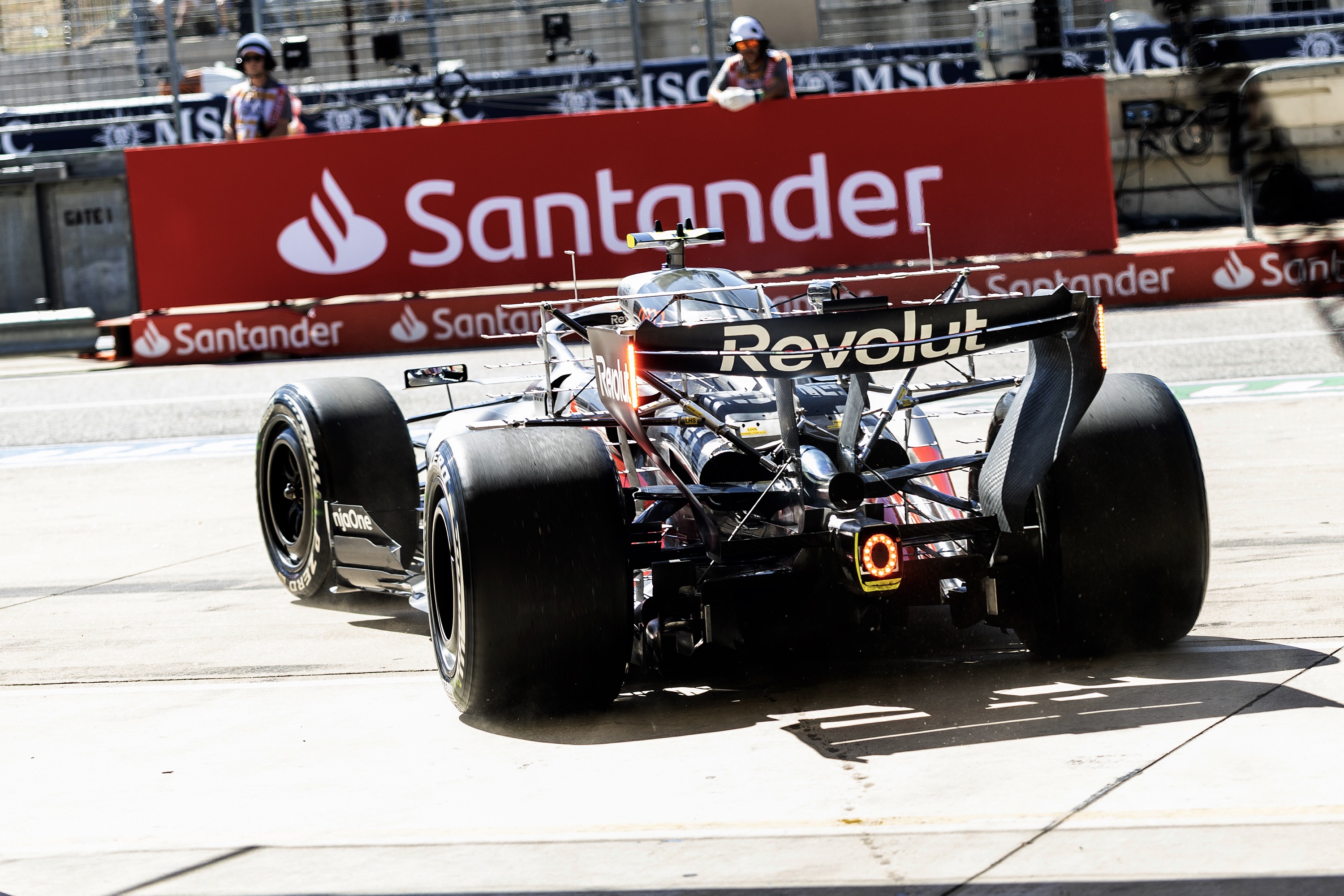
During practice, the cars are instrumented so the team can determine if the upgrades are generating more aerodynamic downforce.
Credit: John Phillips/LAT Images
During practice, the cars are instrumented so the team can determine if the upgrades are generating more aerodynamic downforce. Credit: John Phillips/LAT Images
Even though Audi took over the Sauber team, the fact that Sauber used a Ferrari power unit until last year means Ferrari has all that data, not Audi.
“Every single circuit for us is new,” McNish said. “So we’ve got our pre-profiles and our understanding of ‘yep, this is where we think we are.’ Every race, we are honing that and getting close in the same way as we are doing with aerodynamics and the same way with our simulation to get to the point where we can predict better. But prediction’s one thing. The reality of what you’re fighting against in a race situation can be something different.”
But like this year’s F1 machinery, McNish’s hybrid Le Mans winners were also highly automated. “So in 2014, when they brought in the new regulation for an energy per lap, with that first year, it was very manual, and it was just impossible for the drivers, to the point where I was sitting on the pit wall happy I wasn’t driving because of the brain overload,” McNish said.
Quickly, the power unit control was automated to give the drivers mental bandwidth to manage all the other tasks required during a race stint. “What strategy of tire feedback, the information, maximizing different things on differential… whatever it may be that he’s getting spoken to about. But at the same time, he’s racing. And so the more you can take away from the driver, the better it is,” McNish said.
“However, ultimately, the driver has got to maximize. So there’s a lot of communication with the driver and there’s a lot of adaption as the race goes on. As fuel load comes down, as tires degrade, a circuit grip comes up, as maybe the track cools off as it should do here on Sunday afternoon. So it is definitely adaptive,” McNish told me.
Zzzzzz
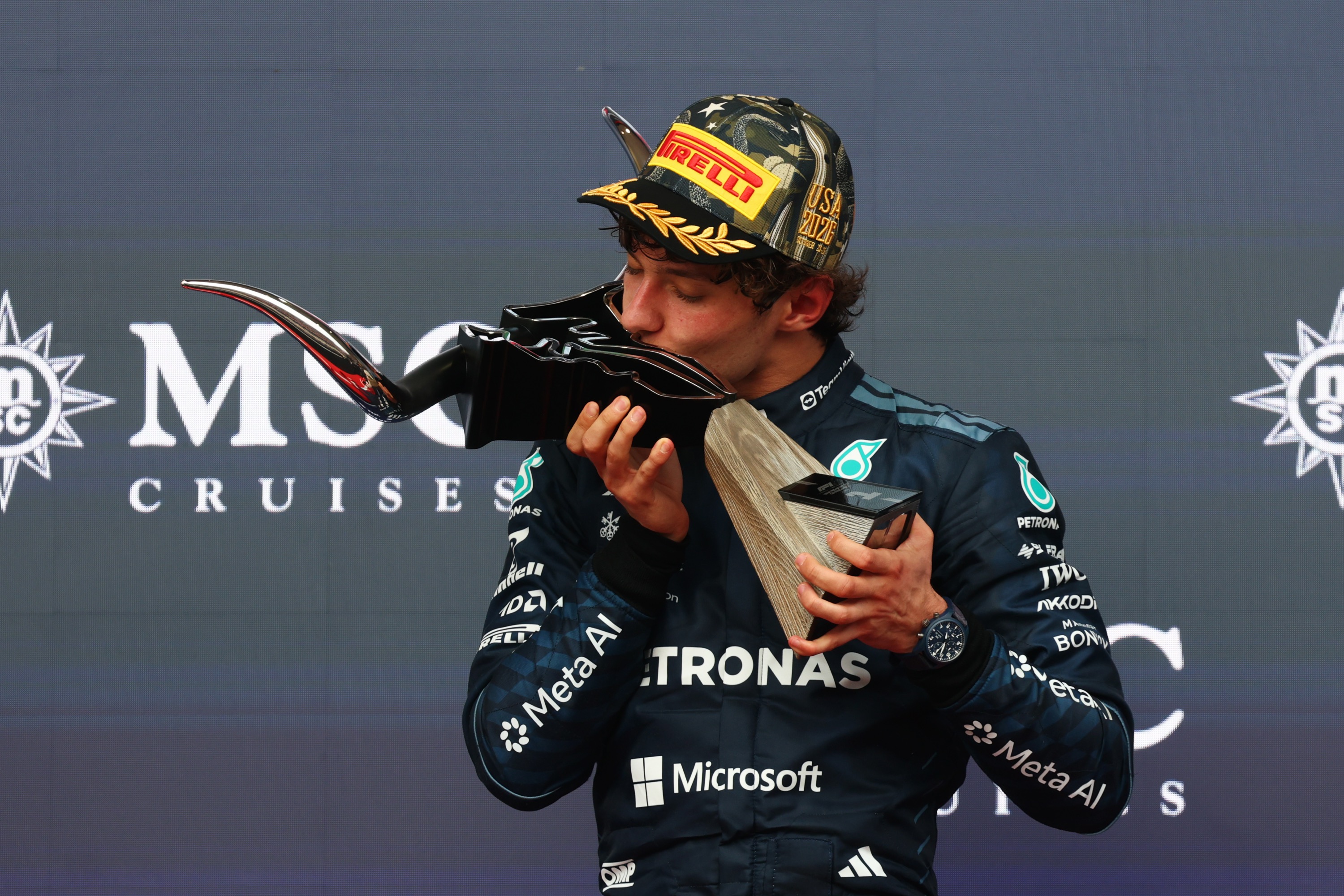
Soon, Antonelli will be F1’s youngest champion.
Credit: Clive Rose/Getty Images
Soon, Antonelli will be F1’s youngest champion. Credit: Clive Rose/Getty Images
The race itself was not one of the season’s more exciting contests. Antonelli scored pole on Saturday and disappeared into the distance on Sunday to win comfortably, extending his lead. George Russell needs to score 23 points more than Antonelli in Mexico City to remain in title contention; Lewis Hamilton must score 24 points more than Antonelli to remain with a mathematical chance. Neither is likely to happen, and we’ll almost certainly see Antonelli seal the deal next time out.
“We’re very close, but we’ll try to finish on a high, and hopefully we can clinch it very soon,” he said after the race.
It was a less successful day for Audi. The team’s fast rookie was handicapped by a 20-place grid penalty for changing power unit components in the lead-up to qualifying, and his teammate Nico Hulkenberg made a poor start and lost five places at the beginning of the race. In the garage, engineers analyzed telemetry screens and even images snapped mere seconds earlier by trackside photographers. Mechanics clad in black waited patiently for the team’s first pit stops. Even though it was the mildest weather I’ve experienced at COTA, it was still stifling in the garage; I was sweating in short sleeves, never mind layers of fire-retardant Nomex.
“Both drivers delivered strong recovery drives today, although unfortunately we came away just outside the points,” said McNish after the race. “For Gabi, starting from the back row following the penalties for the changes we had to make, P13 was realistically the best result available. He drove a clean, very calculated race and made good progress through the field.”
“Nico’s race was compromised at the start when the anti-stall kicked in, dropping him to P15,” he said. “To recover to P11 and to close in on P10 was a superb effort. Ultimately, the result didn’t reflect the performance he delivered or what could have been possible with a clean start. We head to Mexico next week determined to turn that performance into points, and we’ll be back on the attack.”
Jonathan is the Automotive Editor at Ars Technica. He has a BSc and PhD in Pharmacology. In 2014 he decided to indulge his lifelong passion for the car by leaving the National Human Genome Research Institute and launching Ars Technica's automotive coverage. He lives in Washington, DC.
What's Your Reaction?
 Like
0
 Dislike
0
 Love
0
 Funny
0
 Wow
0
 Sad
0
 Angry
0








Comments (0)