

The secret to protecting next-gen spacecraft might be eggshells
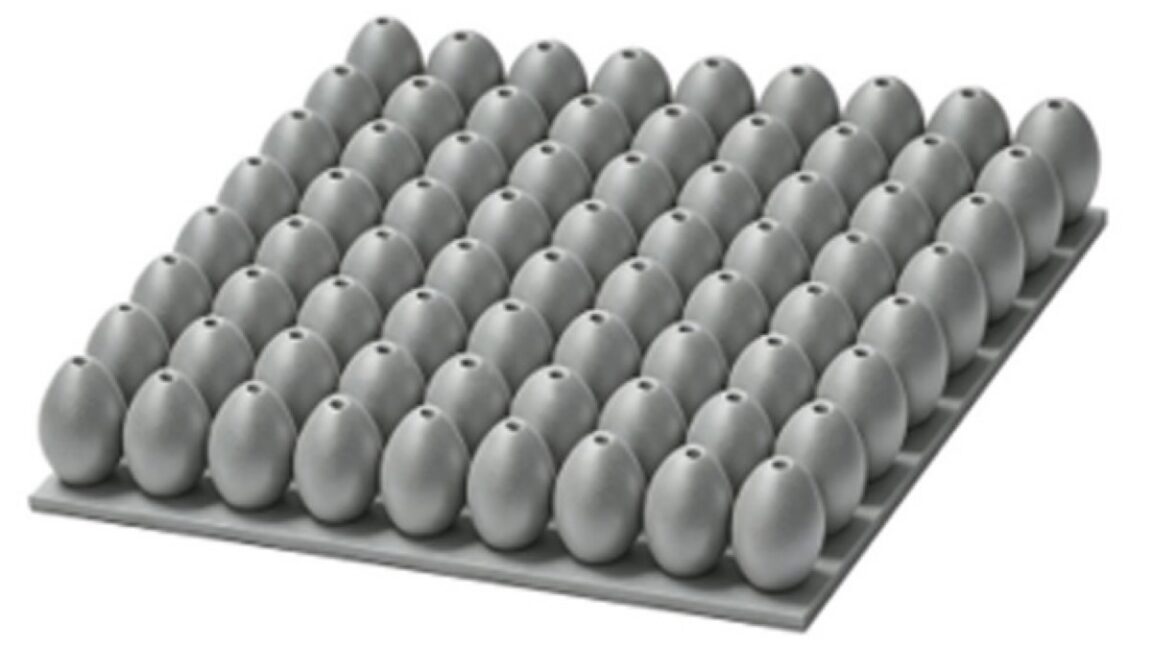
Spacecraft are typically protected from debris impacts by some form of a Whipple shield, which has a thin outer bumper with a space between the bumper and the wall of the spacecraft. The bumper is designed to break up any incoming debris particles, spreading the impact energy over a larger area of the wall. There have been many iterations of the Whipple shield over the decades, including designs with multiple bumpers, or with a filling between the rigid layers (“stuffed” Whipple shields).
The authors of this latest paper wanted to enhance the impact resistance of Whipple shields. They came up with a design similar in concept to the trick for walking across cartons of eggs, drawing on the favorable geometry and biomechanical properties of eggshells. The team 3D-printed three different aluminum designs: just aluminum plates, water-filled aluminum spheres sandwiched between aluminum plates, and eggshell structures filled with water. They ran multiple simulations measuring hypervelocity impacts to determine the most impact-resistant design and conducted light-gas gun experiments on their 3D-printed arrays.
The water-filled eggshell-shaped arrays proved the most effective, withstanding high loads and reducing the velocity of projectiles by nearly 65 percent. Using just aluminum plates reduced the velocity by only 51 percent. The water filling plays an important role in dissipating impact energy, preventing impact waves from propagating as it sloshes around inside the shell.
The authors also tested different eggshell configurations and found that the most effective was one with the eggs placed upright with the narrow tip in contact with the top aluminum plate. More experiments are needed to refine the design and improve the material’s energy absorption, but these initial results are promising.
“A single eggshell breaks easily under local force, but the protection mechanism of the eggshell array is completely different,” said co-author Yuxin Wang of Dalian University of Technology in China. “The cooperative deformation of these eggshell units transforms the local impact load into distributed energy dissipation across the metastructure, thereby significantly enhancing the anti-impact performance of the target plates. We hope this research can attract more attention to bio-inspired protective structures.”
Journal of Applied Physics, 2026. DOI: 10.1063/5.0324502 (About DOIs).
What's Your Reaction?
 Like
0
Like
0
 Dislike
0
Dislike
0
 Love
0
Love
0
 Funny
0
Funny
0
 Wow
0
Wow
0
 Sad
0
Sad
0
 Angry
0
Angry
0







Comments (0)