

Rocket Report: Rebuild begins at Blue Origin launch pad; Relativity targets Mars
A French launch startup is scrapping the name of its rocket, apparently due to a trademark issue.
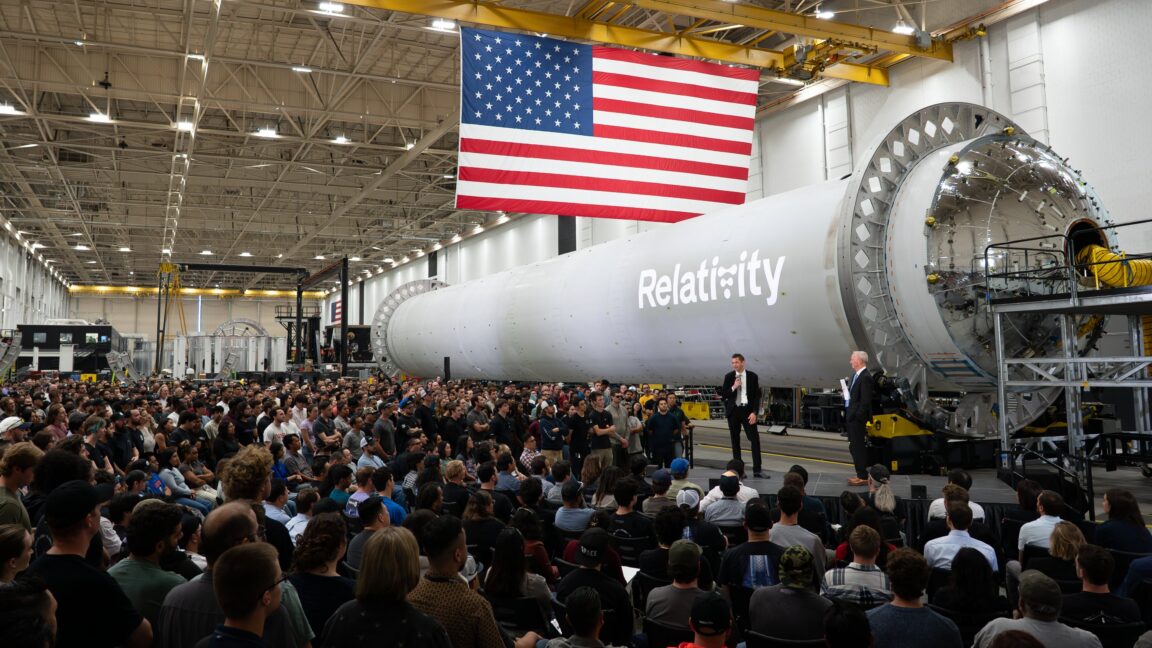
NASA Administrator Jared Isaacman and Relativity CEO Eric Schmidt speak to employees about a new Mars mission. Credit: Relativity Space
Welcome to Edition 8.46 of the Rocket Report! We don’t mention Starship in the body of this week’s report, so I’ll give a brief update here. The next test flight of SpaceX’s mega-rocket—Flight 13—could happen as soon as next month, according to Gwynne Shotwell, the company’s president and chief operating officer, in a recent interview with CNBC. There’s still a fair bit of work to go before Flight 13, so don’t count on a launch next month just yet. What we do know, based on Shotwell’s comments to CNBC, is the next Starship test flight will look a like like the previous one last month, with a suborbital flight path and a splashdown of the ship in the Indian Ocean. SpaceX is holding off on an orbital flight until at least the following launch, Flight 14, after the ship was unable to complete a critical engine restart in space on the last flight.
As always, we welcome reader submissions. If you don’t want to miss an issue, please subscribe using the box below (the form will not appear on AMP-enabled versions of the site). Each report will include information on small-, medium-, and heavy-lift rockets, as well as a quick look ahead at the next three launches on the calendar.

Isar test flight scrubbed again. Isar Aerospace still commands top position among a new generation of European rocket startups, but the company’s efforts to launch a critical test flight of its Spectrum rocket continue to encounter roadblocks, Ars reports. The latest delay came Monday, when Isar scrubbed a launch attempt after “detecting off nominal behavior in the vehicle’s fluid systems,” according to a social media post. “The teams are analyzing the new data to isolate the root cause.” Isar is flush with cash, having raised nearly $1 billion to date, but is still lacking in the critical currently of flight experience. The Spectrum rocket has flown just once to date, on a failed launch last year that lasted less than 30 seconds.
Gravity still winning… The two-stage, 92-foot-tall (28-meter) Spectrum rocket was awaiting liftoff from Andøya Spaceport in northern Norway. It was the fourth time in five months that Isar Aerospace, headquartered near Munich, Germany, had reached a target launch date for the second test flight of the Spectrum launch vehicle. Isar called off a launch attempt on January 21 due to an issue with a pressurization valve, and then halted a countdown on March 25, moments before liftoff, when engineers detected rising temperatures in the rocket’s liquid propane fuel. Isar officials attributed the problem to a delay earlier in the countdown caused by an unauthorized boat in restricted waters along the rocket’s flight path. Managers stood down from another launch attempt on April 9 to evaluate a suspected leak in a composite overwrapped pressure vessel.
The easiest way to keep up with Eric Berger’s and Stephen Clark’s reporting on all things space is to sign up for our newsletter. We’ll collect their stories and deliver them straight to your inbox.
Swift reboost mission ready for launch. Just 10 months ago, NASA asked three companies if they could do something nobody had done before. Could they build and launch a satellite to save a $500 million astronomy mission at risk of crashing back to Earth? What’s more, could they do it in less than a year on a tight budget? The company that came back to NASA with the most compelling solution was a startup named Katalyst Space Technologies, and they have already given the agency a satisfying answer, Ars reports. Katalyst’s reboost satellite, named Link, was built in less than a year and is now integrated with an air-launched Northrop Grumman Pegasus XL rocket for a ride to space slated for no earlier than June 27.
More steps to go… The speed of development of the robotic mission to rescue NASA’s Swift observatory has been remarkable. Now, the mission needs to work. “To be honest, no one thought it was going to be possible. No one thought we would get as far as we’ve already gotten today,” said Shawn Domagal-Goldman, director of NASA’s astrophysics program. “And I have to be honest, there are still risks ahead of us, but I’m both deeply thankful and as optimistic as I can be that we’ll meet those challenges because of the people that have worked on it.” (submitted by EllPeaTea)
New launch pad in the works at Cape Canaveral. Space Launch Delta 45, the military unit that runs Cape Canaveral Space Force Station, is exploring the potential creation of a new rocket launch complex for Naval Ordnance Test Unit and US Army missions, Florida Today reports. The new location, known as Launch Complex 51, would be located about 2 miles north of Port Canaveral, making it the spaceport’s closest pad to public areas. LC-51 would encompass about a 50-acre area.
Better real estate… The new pad would replace Launch Complex 46, which lies within the explosive clear zone of Blue Origin’s nearby Launch Complex 36. Blue Origin’s New Glenn rocket exploded on that launch pad during a preflight test last month. LC-46’s proximity to LC-36 means the two pads cannot operate simultaneously without disruption. LC-46 has hosted a handful of small satellite launches and hypersonic missile tests in recent years.
Changes in attitude at Latitude. French launch startup Latitude has removed all mentions of the Zephyr name from its website, now referring to its rocket simply as “Our Launcher,” European Spaceflight reports. The rocket, previously known as Zephyr, is a two-stage launch vehicle that will stand 19 meters (62 feet) tall and is designed to deliver up to 200 kilograms (440 pounds) to low-Earth orbit. The company is currently targeting the second half of 2027 for the rocket’s inaugural flight.
Due diligence… Latitude did not explain the reason for the change, but one plausible explanation is trademark risk. The Zephyr name is already trademarked within the aerospace sector by Airbus subsidiary AALTO, whose solar-powered High Altitude Platform Station aircraft bears the name. The Zephyr trademark filing, which was granted by the European Union Intellectual Property Office in 2005, covers unmanned aerial vehicles, satellites, parts and fittings, and “launching apparatus for the aforesaid goods.”

China’s Zhuque-2E breaks up in orbit. The upper stage from a commercial Chinese rocket that launched last week has broken apart in space, spreading debris in a heavily trafficked part of low-Earth orbit home to the International Space Station and a significant portion of SpaceX’s Starlink broadband network, Ars reports. The breakup occurred shortly after the Zhuque-2E rocket reached orbit on June 9 with two satellites providing direct-to-cell communications, perhaps around the time the upper stage was expected to perform a disposal burn. The US Space Force confirmed the breakup event in a post on space-track.org, a website used by the military to distribute orbit data to the public.
50, 100, 150?… A US Space Force spokesperson said the military is tracking at least 51 objects attributed to the breakup of the upper stage. That number may increase as the Space Force’s network of tracking radars get a better handle on the debris cloud. Darren McKnight, a senior technical fellow at the orbital intelligence company LeoLabs, told Ars the fragmentation event likely generated 100 to 150 pieces of debris. The second stage of the Zhuque-2E rocket, made by a Chinese company called LandSpace, measured between 25 and 30 feet (about 8 meters) long and 11 feet (3.35 meters) in diameter. The main body of the rocket’s upper stage is now orbiting between 208 miles and 263 miles (335-by-424 kilometers) at an inclination of 54.5 degrees to the equator. This is close to the same altitude of the International Space Station and a number of SpaceX’s Starlink direct-to-cell communications satellites. The good news is atmospheric drag will likely bring most of the debris down within a matter of months to a year.
Relativity announces commercial Mars mission. Relativity Space plans to launch a Mars orbiter in 2028 as part of a new initiative to privately develop planetary missions, Space News reports. The company announced June 17 its Interplanetary Sciences Program, which aims to support science missions in partnership with NASA, industry, academia and philanthropic organizations. The first of those missions is a Mars science and telecommunications orbiter mission planned for late 2028. The payload will include an atmospheric profiling instrument suite contributed by NASA’s Ames Research Center, a radar instrument to map subsurface ice and geology, and a communications relay package.
Short on details... The robotic mission to Mars would launch on Relativity’s Terran R reusable rocket, which is progressing through development in advance of its inaugural flight, perhaps as soon as next year. Relativity offered little information on the mission, such as its size, mass, power, or cost. Since its founding in 2015, Relativity’s central focus has been on launch. Eric Schmidt, the former CEO of Google, took over as chief executive of Relativity a little more than a year ago, teasing new areas of focus such as orbital data centers, philanthropic space science ventures, and national security missions. This isn’t the first time Relativity has touted a Mars mission. Relativity and Impulse Space announced in 2022 plans for a Mars lander that would launch on Terran R, with the lander itself built by Impulse. The companies said in 2023 they were planning to launch the mission as soon as 2026, but neither has provided recent updates on those plans.
Japan’s H3 rocket returns to flight. Japan successfully launched an H3 rocket powered solely by liquid-fueled engines for the first time June 12, overcoming a mission failure six months ago, Kyodo News reports. H3 rocket No. 6, carrying a dummy payload and small satellites, lifted off from the Tanegashima Space Center in Kagoshima Prefecture, two days later than originally planned due to unfavorable weather forecasts at the launch site. JAXA said the rocket was successfully placed into its planned orbit.
Lower cost... This new configuration of the H3 rocket, designated the H3-30S, flies without the aid of solid rocket boosters. Instead, designers added a third hydrogen-fueled engine to the H3’s core stage, which typically has two main engines. The new variant is tailored to launch medium-class satellites at lower cost than the heavier version of the H3 with two or four strap-on boosters. The June 12 launch was the return to flight for the H3 program after a failure in December resulted in the loss of a Japanese navigation satellite. The failure was blamed on the collapse of the H3’s payload support structure, damaging the rocket’s second stage and leading to the unplanned separation of the satellite from the launch vehicle.
SpaceX gives a ride to a competitor. AST SpaceMobile, a company seeking to compete with SpaceX’s Starlink direct-to-cell communications service, launched three “BlueBird” satellites on a dedicated mission aboard a SpaceX Falcon 9 rocket Wednesday, Spaceflight Now reports. The launch followed the loss of AST SpaceMobile’s previous BlueBird satellite on a failed launch of Blue Origin’s New Glenn rocket in April. The satellites are among the largest ever sent into space, with deployable antennas that unfurl to cover an area of about 2,400 square feet (223 square meters) once in orbit. This allows AST to link up with unmodified smartphones on Earth.
Bottleneck... AST SpaceMobile hoped to launch 45 satellites this year, but that was before one of its primary launch vehicles, Blue Origin’s New Glenn, was grounded after an explosion on its launch pad last month in Florida. With this week’s successful Falcon 9 launch, AST SpaceMobile will reach the halfway point of the 2026 with just three new satellites in orbit.

For Amazon, Europe’s Ariane 6 stands apart. Amazon now has hundreds of flight-ready satellites standing idle in Florida, waiting to join the company’s low-Earth orbit Internet constellation, Ars reports. “They’re built, and sitting in a payload processing facility waiting for trips to orbit,” said Steve Metayer, vice president of Amazon Leo Production Operations, during a teleconference with reporters. “And we’re currently manufacturing several satellites a day.” Several years ago, Amazon entrusted three unproven rockets—United Launch Alliance’s Vulcan, Blue Origin’s New Glenn, and Europe’s Ariane 6—to launch the bulk of the company’s constellation of more than 3,200 satellites. Of that group, only the Ariane 6 has come through for Amazon.
A new lift record for Europe… France-based Arianespace has emerged as a critical partner for Amazon, which, to date, has had the majority of its 331 satellites launched on Atlas V rockets. However, Amazon has just one more mission booked on this rocket, which is operated by United Launch Alliance, as the vehicle is slated for retirement. Arianespace’s Ariane 64 rocket launched its third mission for Amazon Wednesday morning from French Guiana. This mission debuted larger strap-on solid rocket boosters, increasing the Ariane 64’s carrying capacity from 32 to 36 Amazon Leo satellites. It also marked the heaviest payload ever launched by a European rocket.
Rebuild underway at Blue Origin’s Florida launch pad. Blue Origin has started rebuilding a launch pad severely damaged in a New Glenn explosion less than three weeks ago as it works to resume launches by the end of the year, Space News reports. Jeff Bezos and Dave Limp, Blue Origin’s owner and CEO, spoke about the pad rebuild at the VivaTech conference in Paris. Limp said Launch Complex 36 has been cleared of all debris, and crews “started the reconstruction” of the pad earlier this week. Both reiterated their earlier statements that Blue Origin will fly the New Glenn rocket again before the end of the year, an achievement that would defy the expectations of many officials at NASA.
Mark 1 next year… NASA has a keen interest in the reconstruction of the launch pad and the return to flight of New Glenn. The rocket is a key element in the agency’s Artemis program to return US astronauts to the surface of the Moon. Blue Origin’s first prototype lunar lander, called Blue Moon Mark 1, was supposed to launch in the next few months on a New Glenn rocket to begin testing core technologies for a future human-rated Moon lander. After the pad explosion last month, NASA Administrator Jared Isaacman suggested Blue Origin look for an alternate rocket for the Mark 1 lander. Limp said that won’t be necessary, stating that Mark 1 is now targeted for launch early next year, once New Glenn is back in service.
Next three launches
June 21: Falcon 9 | Starlink 17-28 | Vandenberg Space Force Base, California | 14:00 UTC
June 23: Long March 7A | Unknown Payload | Wenchang Space Launch Site, China | 02:10 UTC
June 23: Falcon 9 | Starfall Demo | Cape Canaveral Space Force Station, Florida | 09:43 UTC


Stephen Clark is a space reporter at Ars Technica, covering private space companies and the world’s space agencies. Stephen writes about the nexus of technology, science, policy, and business on and off the planet.
What's Your Reaction?
 Like
0
Like
0
 Dislike
0
Dislike
0
 Love
0
Love
0
 Funny
0
Funny
0
 Wow
0
Wow
0
 Sad
0
Sad
0
 Angry
0
Angry
0






Comments (0)