

Rocket Report: India's Vikram-1 nears debut flight; AST to become rocket company?
“We have done everything that could be done to test Vikram-1 on ground.”
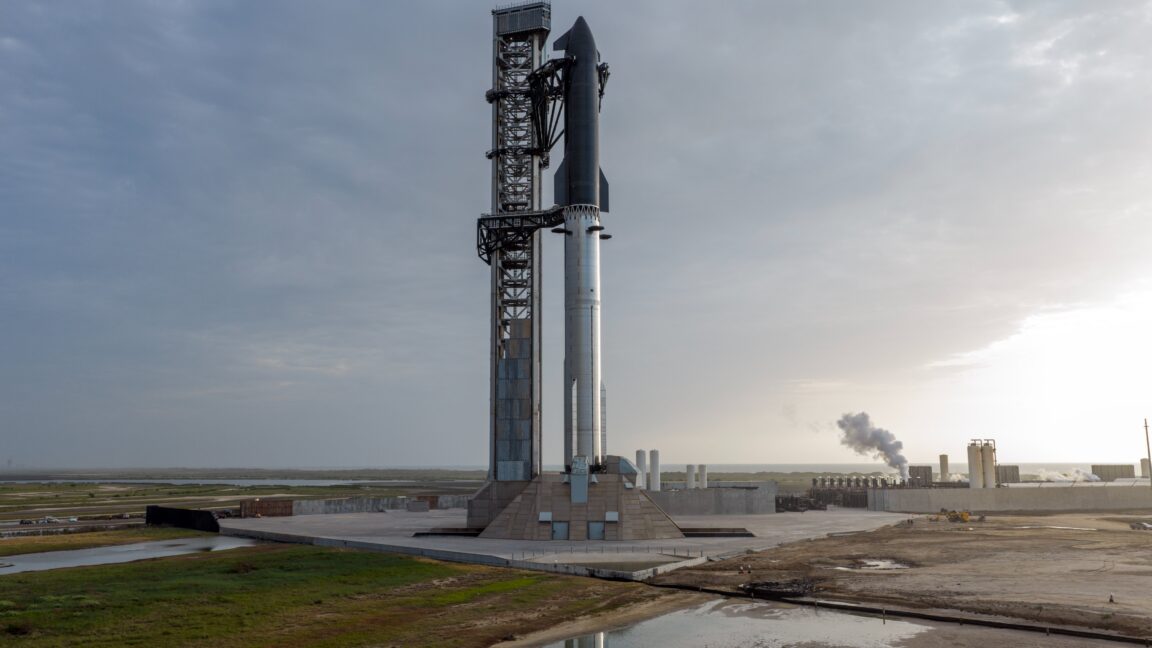
SpaceX's Starship rocket did not leave the launch pad on Thursday, as intended. Credit: SpaceX
Welcome to Edition 9.03 of the Rocket Report! SpaceX counted down all the way to T-0 on Thursday evening in South Texas before a handful of Raptor engines decided not to light at ignition of the rocket. It is not clear whether the vehicle can be worked on at the pad, or whether Starship will need to be de-stacked before this can occur. In any case, a few days delay beats a significant issue in flight.
As always, we welcome reader submissions, and if you don’t want to miss an issue, please subscribe using the box below (the form will not appear on AMP-enabled versions of the site). Each report will include information on small-, medium-, and heavy-lift rockets as well as a quick look ahead at the next three launches on the calendar.

Vikram-1 rocket gets a launch date. The debut launch attempt by Skyroot Aerospace of its Vikram-1 rocket is now set for July 18, at 11:30 am local time in India. This will be the first time a commercial rocket developed in India attempts to reach orbit. Designed to carry small satellites weighing up to 350 kg to low-Earth orbit, Vikram-1 is targeting a 450 km orbit at a 60-degree inclination.
A major step for India … The new rocket will carry technology demonstration payloads from Grahaa Space, Cosmoserve, DCubed, and Skyroot’s own SCOPE, along with Cosmos Diamonds’ artwork “Cosmic Bloom” and a micro-art piece. “We have done everything that could be done to test Vikram-1 on ground,” said Pawan Kumar Chandana, co-founder and chief executive of Skyroot, in an emailed news release. “We are eager to see how Vikram-1 performs in real flight environment for the first time. This is our first test flight, and we will be getting valuable data from it.”
Japan conducts rocket landing test. Japan’s space agency has conducted a test flight of its experimental reusable rocket in a northern part of the country, the Japan Broadcasting Corporation reports. JAXA said the rocket took off and landed as planned after reaching a height of about 11 meters. The flight lasted about 40 seconds and included a 16-meter horizontal translation relative to the ground before landing.
Step by step … JAXA has been developing the RV-X rocket to demonstrate technologies needed for a reusable launch vehicle. The conical fuselage stands about 7.3 meters tall and is somewhat similar in appearance to the DC-X vehicle developed by NASA in the 1990s, and SpaceX’s Starhopper. The agency says it plans to analyze the data from the flight for the development of an experimental reusable rocket in a joint project, called CALLISTO, with French and German research institutions. (submitted by tsunam)
The easiest way to keep up with Eric Berger’s and Stephen Clark’s reporting on all things space is to sign up for our newsletter. We’ll collect their stories and deliver them straight to your inbox.
A new suborbital test range Down Under. A company called Spinifex Space was established this week to provide end-to-end suborbital launch campaigns, private range access, and test and evaluation infrastructure from facilities in southwestern Queensland, Payload reports. Spinifex says its team spun out of Black Sky Industries, an Australian developer and supplier of solid rocket propellant and solid rocket motors.
Helping others get to space … Spinifex itself does not build rockets. Instead, its products are the land and the licenses required for flight. The company will support static-fire testing, hypersonic vehicles, kinetic effectors, energetics handling, and destructive testing. The closest domestic alternative is Woomera, the government-owned range where Australia tests its missiles.

China lands orbital booster. China’s sprawling state-owned rocket developer, maker of the country’s Long March rocket family, announced it recovered a reusable orbital-class booster for the first time last Friday in the South China Sea. The milestone mission began with the liftoff of a medium-lift Long March 10B rocket from the Wenchang Commercial Space Launch Site on Hainan Island, Ars reports. About 10 minutes later, the Long March 10B booster descended from space and guided itself into a four-legged frame affixed to an offshore vessel. Tensioned cables, stretched over the ship in a grid pattern, captured the rocket as it shut down its landing engines, leaving the smoldering booster hanging in midair.
Joining Western rocket companies in the club … The rocket’s upper stage continued into orbit and deployed a payload known only as CX-26. Chinese officials hailed the flight as a “complete success.” SpaceX and Blue Origin use propulsive landings to return their Falcon 9 and New Glenn boosters to offshore platforms or onshore landing pads. With Starship, SpaceX pioneered a new method of catching the rocket’s reusable booster back at its launch pad using mechanical arms mounted to the launch tower. (submitted by tsunam)
AST SpaceMobile seeking other launch vehicles. The direct-to-cell satellite company announced its intention to offer $1 billion in convertible notes on Wednesday after the US stock market closed. Shortly after the announcement, the stock value dropped more than 10 percent as investors appeared concerned about dilution of their shares. What is interesting for our purposes is the reason offered by AST SpaceMobile for the transaction: the need for more rockets to get its large BlueBird satellites into orbit.
Company considering acquisitions … AST SpaceMobile intends to “pursue an expanding universe of growth initiatives and secure additional access to orbit for its space-based cellular broadband network, including partnerships and/or acquisitions to further vertically integrate its business and mitigate risks associated with third-party launch providers.” The decision follows the failed static-fire test of a New Glenn rocket in April, which was due to launch a BlueBird satellite to expand the company’s constellation. The company’s plan for future launches on New Glenn are necessarily on hold.
Japan seeks to increase launch activity. The Japanese government wants to sharply increase the number of launches despite struggles with both current and new launch vehicles, Space News reports. The country would like to increase the number of government and commercial launches to 30 per year by the early 2030s. That is an ambitious target, because Japan, to date, has conducted just two orbital launches in 2026.
It’s a stretch goal … An H3 rocket launched June 11 on a test flight of a new variant of the vehicle. That launch also served as a return to flight for the H3 family after the previous launch in December failed to place its payload, a navigation satellite, into orbit. The other was the third flight of Kairos, a small launch vehicle developed by Space One, on March 4. It was a failure. One way to reach the goal of 30 launches a year is for Japan to host launches of foreign rockets, officials said.
Ariane 6 is cleared to launch CubeSats. The European Space Agency has awarded a contract to launch its solar storm-monitoring CubeSat on an Ariane 6 rocket, European Spaceflight reports. Scheduled for launch in early 2027, the Henon CubeSat will be flown as a secondary passenger alongside the space agency’s PLATO telescope, which will be tasked with finding Earth-like exoplanets.
Up to 16 satellites … Before the award, a feasibility study was conducted to confirm that CubeSats could be safely accommodated as secondary payloads aboard an Ariane 6 flight. “Henon was a reference case, but we also looked at how many CubeSats could be accommodated in this launch architecture,” said Roger Walker, head of CubeSat missions at ESA. “We can fit up to four 16U CubeSats, in fact.” After the launch, Henon will use its miniaturized electric propulsion system to maneuver into a distant retrograde orbit around the Sun.

Starship test flight is scrubbed at ignition. The next test flight of SpaceX’s Starship spacecraft and Super Heavy booster was set to launch as soon as Thursday, Ars reports. However, a handful of the rocket’s 33 Raptor engines failed to light at the vehicle’s ignition, and therefore the launch attempt was aborted automatically. Shortly after this abort on Thursday evening, SpaceX founder Elon Musk said the next launch attempt would “hopefully” take place in a few days.
Seeking validation … For this flight technicians have installed 20 Starlink V3 satellites into the ship’s deployer, a system of pulleys and cables designed to eject a stack of satellites one at a time through an opening on the side of the spacecraft. The satellites will not be part of SpaceX’s operational network, but engineers will attempt to briefly establish laser communication links between the Starlink V3s and other spacecraft flying in low-Earth orbit. If successful, these links will validate Starlink V3’s interoperability with SpaceX’s previous generation of Starlink satellites.
How many launches to build a data center megaconstellation? In a new feature, Ars looks into the technical challenges of building orbital data centers and assesses what it might take to build SpaceX’s proposed 1 million satellite megaconstellation. The key to all of this is not radiation or the need to cool data centers in space. The single-most important factor is cheap access to space. For the purpose of the analysis, Ars modeled three scenarios: high-performing Starship and low-satellite mass; medium-performing Starship and satellite mass; and low-performing Starship and high-mass satellites.
The numbers are pretty daunting … The optimistic scenario would require 17,500 Starship launches to deploy 1 million satellites. The most pessimistic scenario would require 77,000 total launches. Over a period of five years, by the way, for the pessimistic scenario that would be 42 Starship launches a day. As for total costs, including launches, satellites, and ground systems, under the most optimistic scenario the constellation could be deployed for $1.45 trillion. Pessimistically? Hold your breath: It’s $9.8 trillion.
NASA mission moves to Falcon Heavy. NASA’s SunRISE (Sun Radio Interferometer Space Experiment) mission will launch on a SpaceX Falcon Heavy rocket from the agency’s Kennedy Space Center in Florida, the space agency said this week. As part of the announcement, NASA did not announce a launch date for the heliophysics mission, which had originally been scheduled to launch on United Launch Alliance’s Vulcan rocket.
Six new eyes on the Sun … The mission is flying as a rideshare sponsored by the United States Space Force’s Space Systems Command. SunRISE comprises six toaster-oven-size small satellites, or SmallSats, that will operate as one giant radio dish slightly above geosynchronous orbit (about 22,000 miles, or 35,000 kilometers, in altitude) to track the rumbles of radio bursts coming from within the Sun’s atmosphere, or corona. (submitted by Tfargo04)
Next three launches
July 16: Starship | Flight Test 13 | Starbase, Texas | 22:45 UTC
July 18: Vikram 1 | Aagaman test flight | Satish Dhawan Space Center, India | 06:00 UTC
July 20: Falcon 9 | Starlink 17-39 | Vandenberg Space Force Base, Calif. | 14:00 UTC


Eric Berger is the senior space editor at Ars Technica, covering everything from astronomy to private space to NASA policy, and author of two books: Liftoff, about the rise of SpaceX; and Reentry, on the development of the Falcon 9 rocket and Dragon. A certified meteorologist, Eric lives in Houston.
What's Your Reaction?
 Like
0
Like
0
 Dislike
0
Dislike
0
 Love
0
Love
0
 Funny
0
Funny
0
 Wow
0
Wow
0
 Sad
0
Sad
0
 Angry
0
Angry
0










Comments (0)